




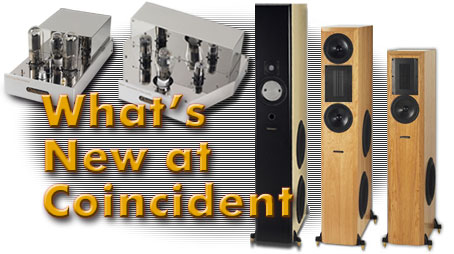

Product News
Frankenstein 300B Stereo Amplifier
Available Options on Coincident Speakers
Technical Notes


Invictus Loudspeaker
|
|
|
|
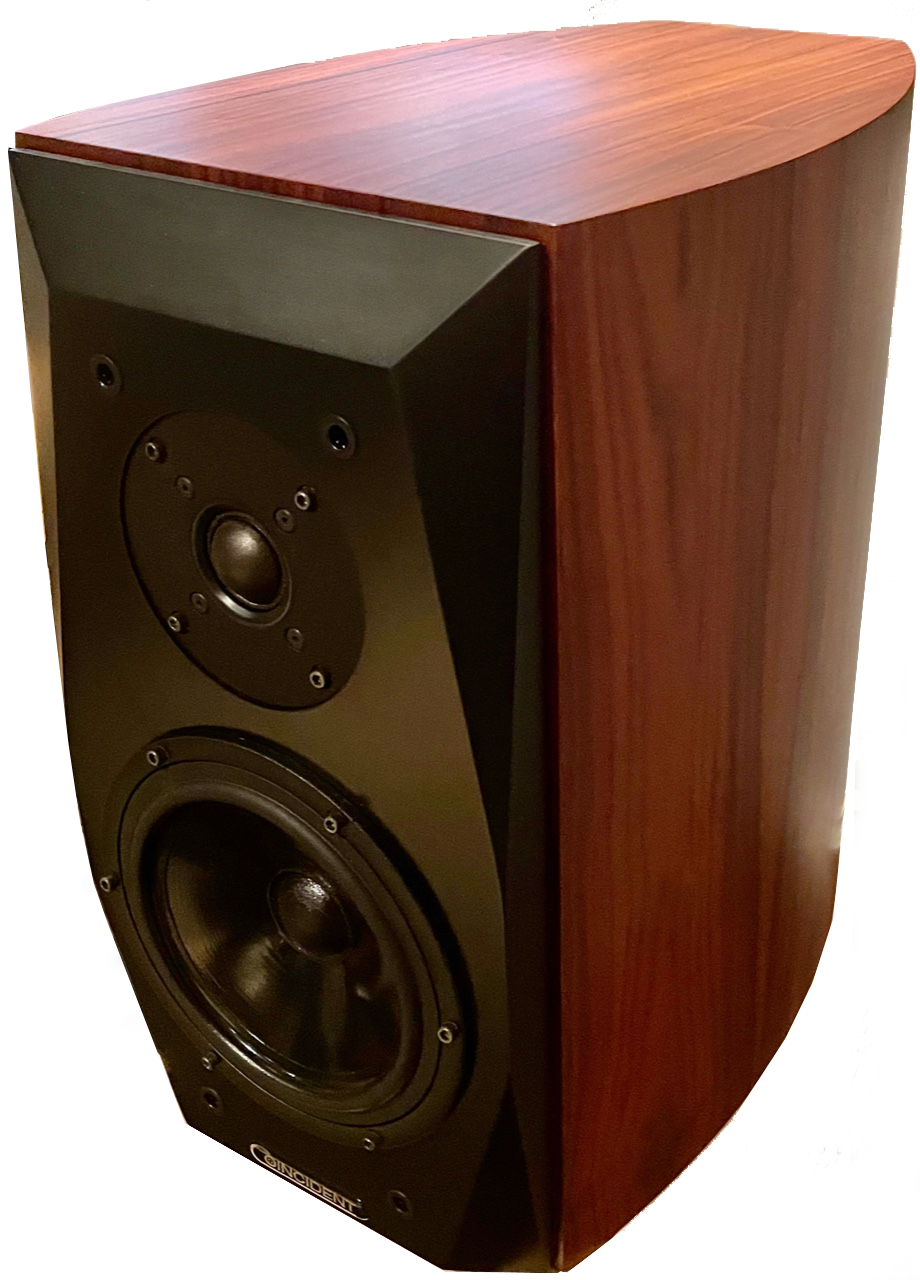
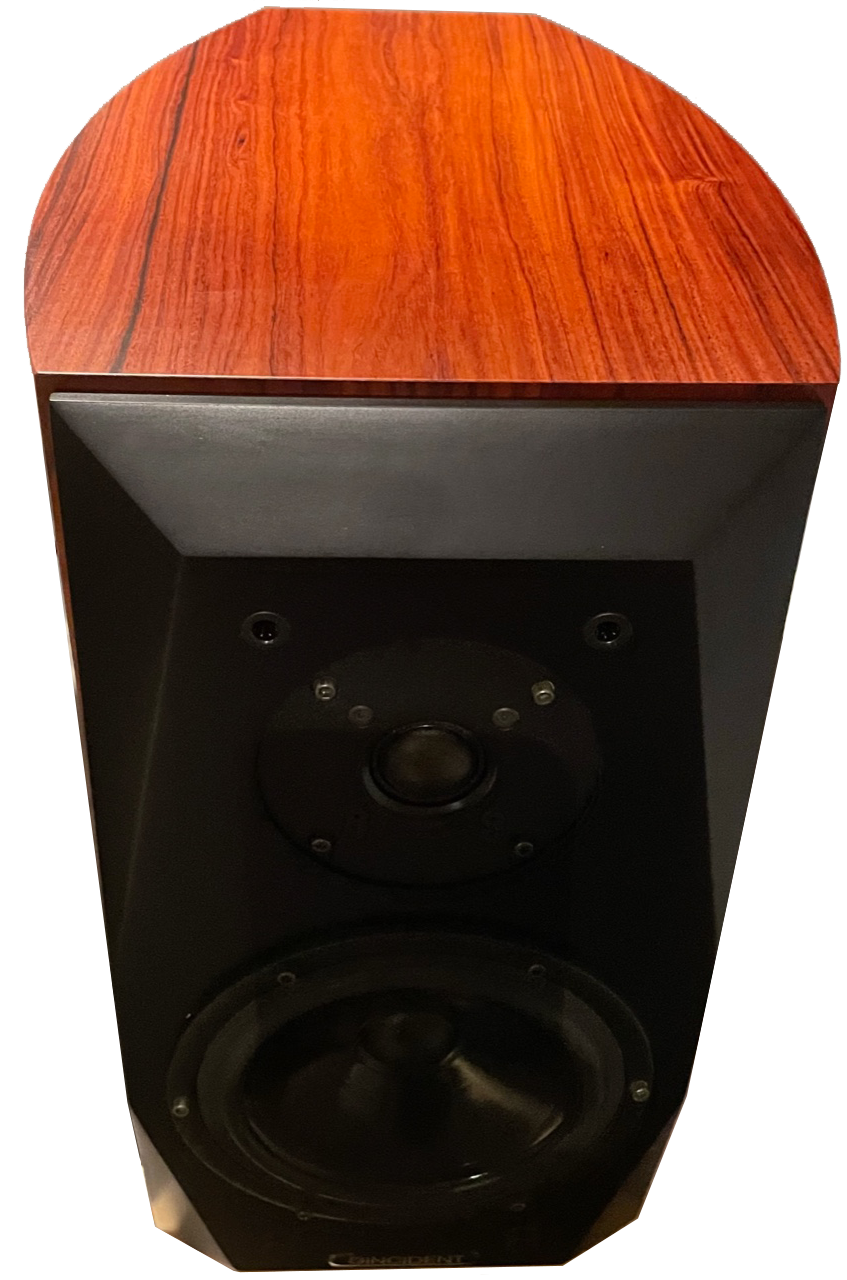
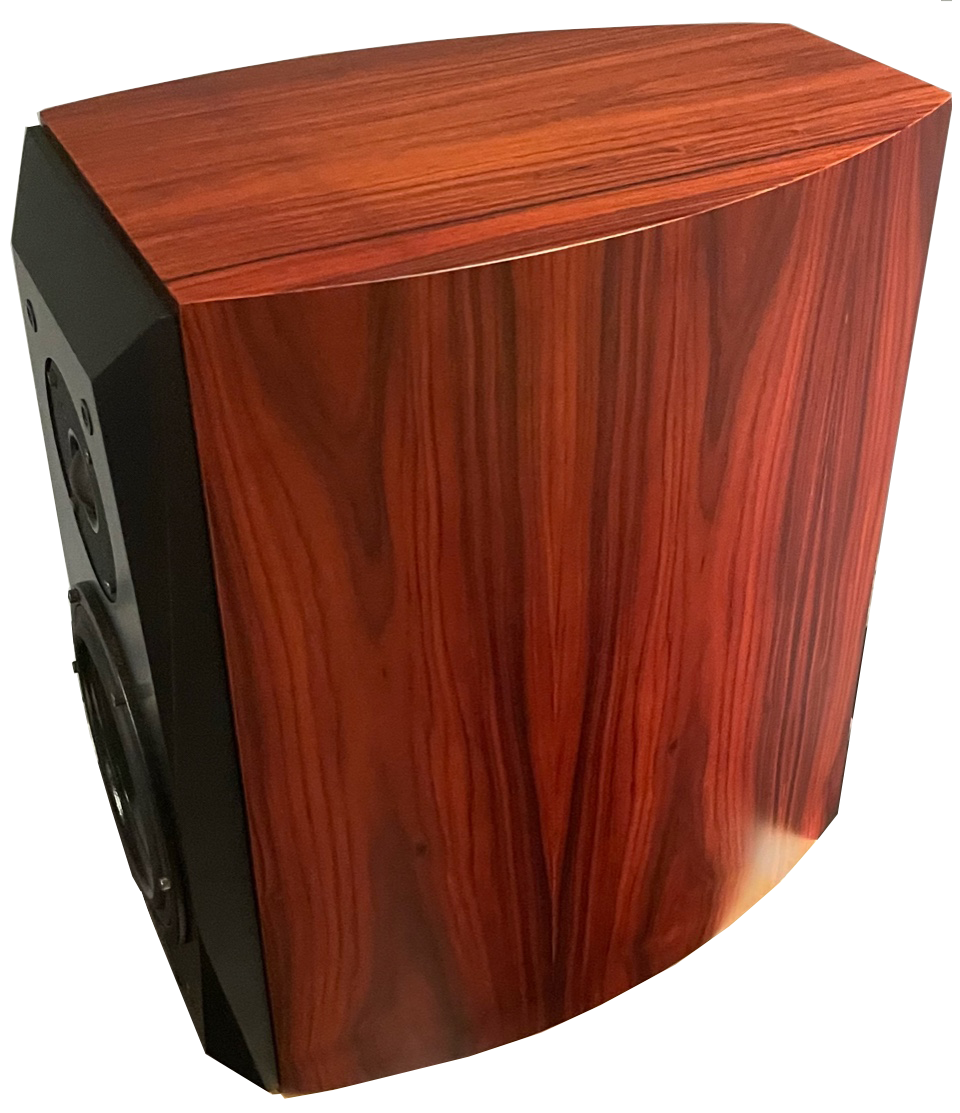
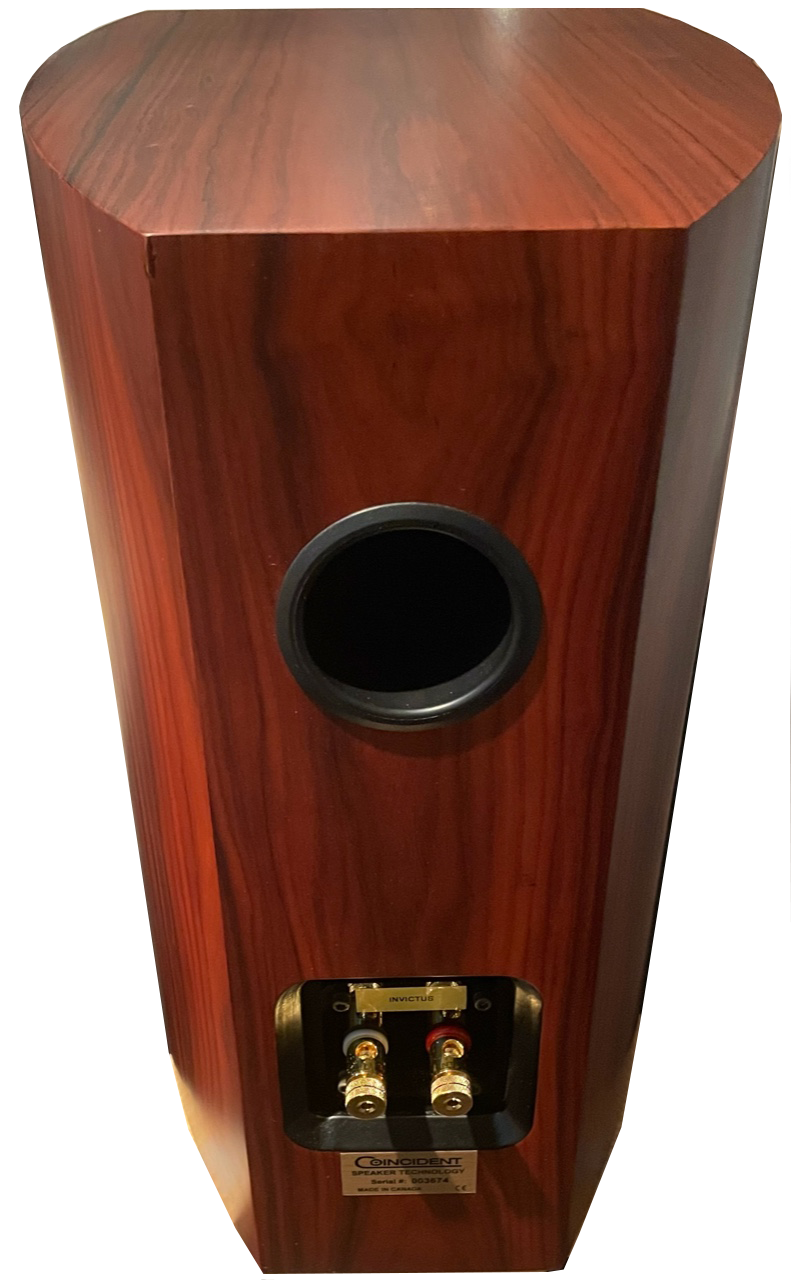
Coincident is excited to introduce our first bookshelf speaker since the renowned Triumph Signature Extreme 8 years ago. We waited this long because our goal was to create a compact speaker that would be uniquely special and could perform at a level that would satisfy the most ardent audiophile and the most devoted music lover. The speaker had to be capable of being powered by any amplifier - from SET to high power tube or solid state and every amp in between. It had to remove its presence from the music which meant it had to reproduce all the music on a recording without any errors of omission or commission. Compact size yet capable of 32 hz bass, beautiful to behold and accessible pricing comprised all the other fundamental requirements. A daunting task to say the least, but the Invictus has realized all our lofty and inclusive aspirations. The Invictus is simply a Herculean achievement that fully addresses and succeeds on all our intentions.
Tweeter - Is a special version of a proprietary design of the Scan Speak legendary Revelator. The double magnet system offers high sensitivity with virtually unlimited power handling. The exceptionally low resonance frequency ( 600 hz), results in optimum fidelity within its used range which is 3000 hz- 25 kHz. Furthermore, the impedance modulus remains flat between 6-8 ohms which maximizes consistent amplifier power delivery.The tweeter exemplifies high end articulation and revelation of detail with the absence of artificial artifacts. Detail without edge or brightness.
Woofer - Bespoke special version of the SEAS 7" woofer with unique paper cone and special polymer damping which results in a cone devoid of flexing and break up which makes it impervious to distortion during high volume music listening. Massive magnet structure and high gauge magnesium basket ensure no vibration or rigidity issues when confronted with wide dynamics and low bass. The low end in the specially devised Invictus enclosure is flat to an astonishing 35 hz with 30 hz response being only 3 db down. No need for bass augmentation with the Invictus. The low end is remarkably impactful and full bodied. The midrange reproduction is sublime and will highly impress with the natural rendering of human voices and associate instruments. Low level detail retrieval is uncanny as is the capturing of full harmonics. The illusion of instruments and vocals playing in the music room will disarm and enchant.
Enclosure - is not only strikingly aesthetically stunning it adheres to the sought after ambition of uniting form and function. Novel bow construction technology minimizes internal standing waves and creates a structure that is non resonant and free from undesirable vibrations. All walls are 1' thick with the front baffle being 2" thick., which ensures an enclosure that is fully isolated from driver inertia. The internal volume of the enclosure was precisely calculated to generate flat 35 hz response, which is highly unique for a speaker this size.
Crossover - In keeping with the Coincident philosophy of utilizing only the finest components and in the simplest scientific methodology, there is only one capacitor and one inductor in the signal path. This creates a first order crossover that ensure purity of sound and phase coherency. This technique is only possible when state of the art drivers , with wide range frequency response is employed.
Specifications:
Sensitivity: 92 db -1 watt @ 1M
Impedance: 8 ohms - very linear phase coherency
Power Requirements: 3 watts- 200 watts
Frequency Response: 35 hz - 22 khz- +/- 3 db
Dimensions: 16" H x 10" W x 15" D
Weight: 41 lbs ea.
Price: $2999 US - Introductory Price.
Frankenstein 300B Stereo Amplifier
|
|
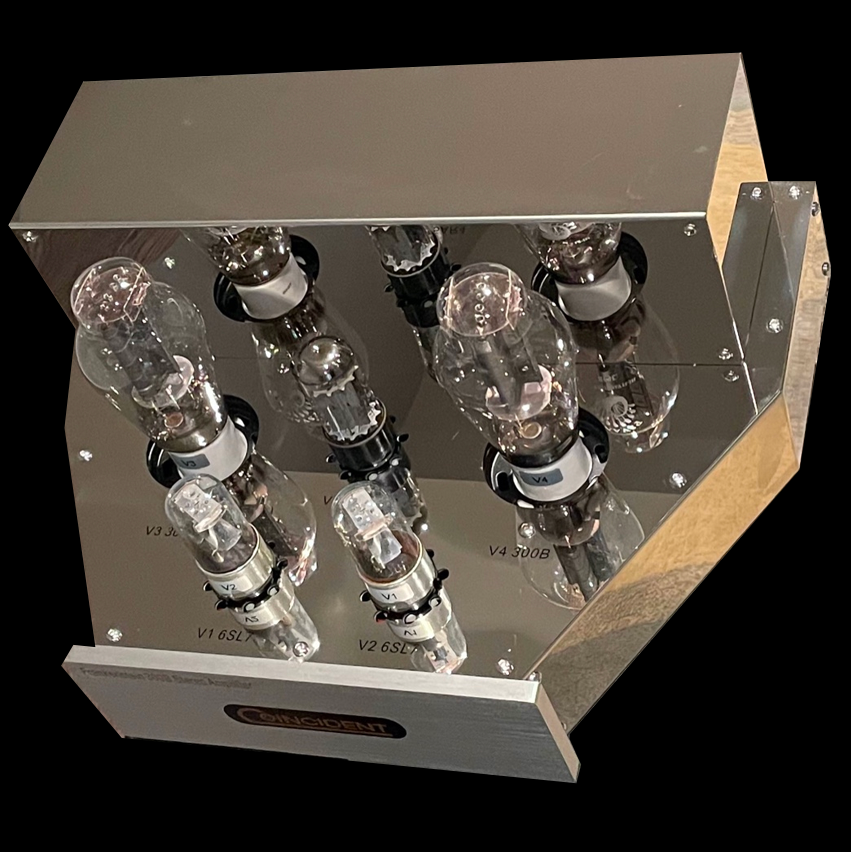
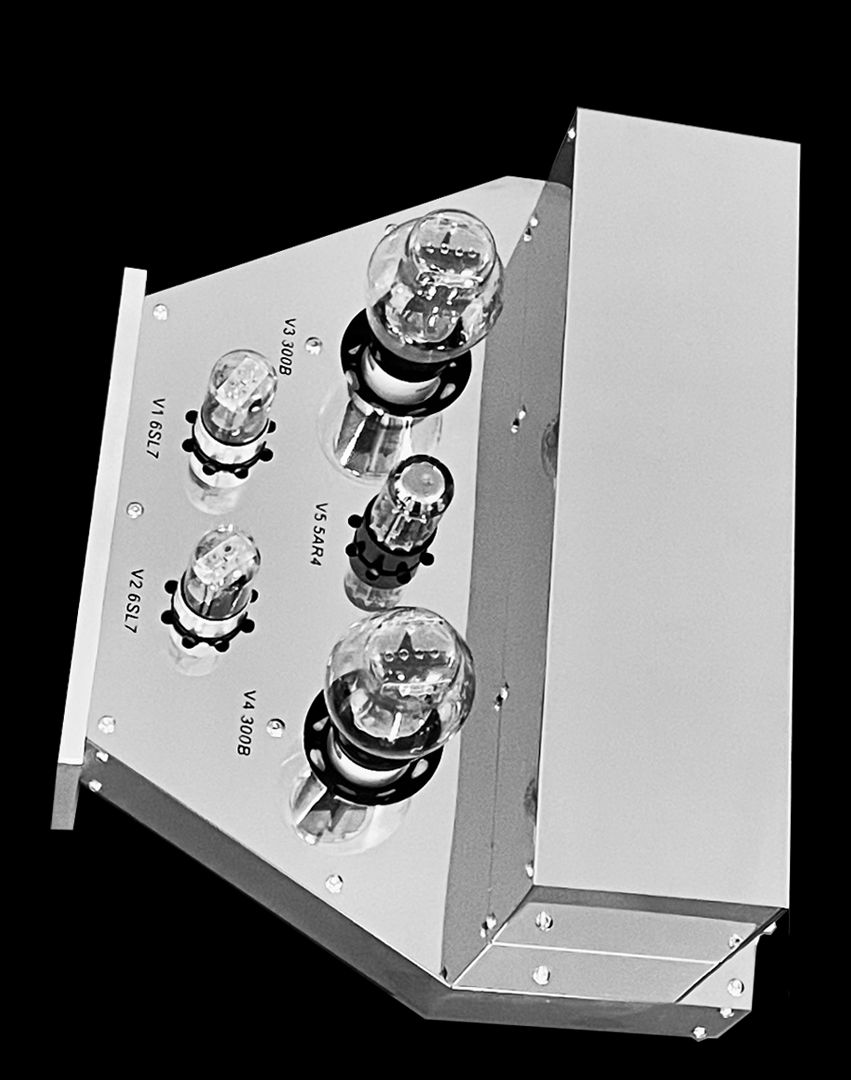
Coincident is excited to introduce the newest addition to our series of power amplifiers - the Frankenstein 300B Stereo Amplifier. The Frankenstein 300B Stereo amplifier is the stereo version of the highly acclaimed Frankenstein M300B Mono Amps. The two Frankenstein amps share the exact same mirror finish stainless steel chassis, virtually the same design and circuitry and industry breakthrough performance. The differences are the Stereo amp uses the 6SL7 input tube instead of the 6EM7 and utilizes the 5AR4 rectifier instead of the 5U4GB. Both are all hardwired share the vast majority of components. The Frankenstein Stereo 300B will be the best constructed, finest performance and best value of any single ended 300B available. It represents a breakthrough at its reasonable price point.
Specifications
Output Power - 8 watts RMS SE class A
Output Impedance - 8 ohms
Frequency Response- 10hz- 20khz- +/- 1db
THD- less than 1% 20 hz - 20 kHz
Input Sensitivity - 800 MV full output
Input Impedance - 47K ohms
Power Requirements- AC 115V or 230V 50,60hz ( user selectable on the rear panel)
Dimensioin - 15” W x 12” D x 8.5” H
Net Weight - 17 kgs- 38 lbs.
Tube Compliment - 6SL7 x2, 300B x 2, 5AR4 x 1.
Price - $2499 US, All tubes included except 300B.

Pure Reference Extreme MK II
Arthur Salvatore- highendaudio.com
My conclusion is straightforward, and consistent, with the above review: I already Doubled-up the original PRE speakers back in 2010, and achieved outstanding results (reported in detail at the time). Thus, it is no surprise that the current results with the PRE Mk. II Doubles are also outstanding. The above review of the PRE Mk. II Doubles provides all of the supporting and confirming details as to why I arrived at such a highly positive evaluation. However, I believe my purely personal and subjective response may also be important to many readers. Accordingly, while I truly dislike repeating myself, in this instance I believe it is instructive for us to again go back to the 2010 review of the Original PRE Doubles, and specifically to a relevant conversation I had with Jean Nantais (Lenco Reference) during the very first night we heard them. This is what I wrote at the time..
To paraphrase Nantais; "This is the first time I've ever heard an audio system with no limits. It does everything". After hearing Nantais' words, I was silent for a while. Finally, I told him that I agreed with him. I told Nantais that these speakers gave me a feeling of confidence that there was nothing they could not do, and that this was the first time I've ever experienced this, in my own system, or anywhere else. Further, while it obviously took the entire system to achieve this highest level of performance, it could only be the speakers that were able to finally put it "over the top". Let me explain...
From my experience, there are now (and have been in the past) many "big speakers" that can play loud (cleanly), sound "big" and go low and high, but not without easily noticeable problems, especially at lower volume levels. However, the PRE Doubles can equal these "big speakers" in their mentioned strengths, while avoiding their (once thought unavoidable) problems. This reality became increasingly clear to me that evening, especially after I had heard a few particularly challenging records, now forgotten unfortunately, that were reproduced in a manner which I had never experienced in the past.
Now, is there anything I can add to the above in 2021? Yes. The PRE Mk. II Doubles perform at such a high level that an accurate subjective description of their full capabilities may even appear to be contradictory at times, so let me use some analogies. The Doubles are like a combination of the skills and abilities of both a flyweight and heavyweight boxing champion, simultaneously, or both a Bolshoi ballerina and an Olympic shot putter, simultaneously. In short, to repeat, and summarize, the various subjective quotes in the Original PRE Double review; "It does it all", period.
Further, and most important, I believe the majority of current (and future) owners of the PRE Mk. II can also experience highly satisfactory results when they invest in the PRE II Doubles. However, their existing system must be ready for the "creation" of such a highly-revealing instrument. This means the capability of bi-amping, outstanding sources, good quality AC, etc. The PRE Mk. II Doubles will reveal virtually everything, including, unfortunately, every system weakness, so be well prepared.
The Absolute Sound - January/2020
Coincident Statement Phonostage
Jacob Heilbrunn
The collected letters of Ralph Ellison, who wrote the classic novel Invisible Man, were recently published by Random House. Among them is a lengthy missive from Ellison in March, 1985, to a childhood friend that discusses their old mutual fascination with audio equipment. After describing how he built his own amplifier based on the circuit of a Williamson amplifier that had been discussed in Audio magazine, Ellison goes on to reminisce about what a treat it was to visit the home of the legendary conductor Arturo Toscanini to help transfer a number of his early recordings to tape. But towards the end of his letter, he remarks that technological advances put the kibosh on his love for the hobby: “Never long on theory, I was simply too busy writing and teaching to make the abrupt transition from vacuum tube to transistor. As a result, I no longer enjoy the pleasure of hanging around surplus electronics stores, checking out new circuits, or stinking up the house with soldering flux.”
Ellison spoke too fast. As any audiophile knows, tubes have made a comeback since those dire days. In paying tribute to Bill Conrad and Lew Johnson, who were recently inducted into the TAS Hall of Fame, Dick Olsher stressed the contribution they made to revitalizing tubes as a key part of modern audio systems. Indeed, a number of companies have devoted themselves to producing tube gear or, like Audio Research, never given up in the first place. Their pursuit isn’t a matter of nostalgia for the past. The truth is that tubes possess an ineffable quality that transistors, whatever their technical merits, sorely lack.
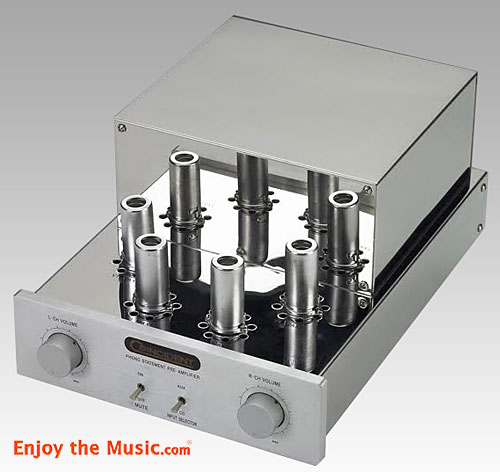
Enter Israel Blume, the president of the Canadian-based company Coincident Speaker Technology. In an interview with my TAS colleague Neil Gader in 2015, Blume remarked, “I listen to the best digital and my reaction is positive until I put a great LP on my reference turntable.” Blume not only manufactures loudspeakers but also a formidable line of tubed equipment that has a distinctly retro look to it. With a hefty power supply that can apparently drive a 100-watt amplifier and is connected to the phono preamplifier by an umbilical cord, Blume can hardly be accused of skimping on the hardware. The workmanship looks nifty as well, though I should note that the positive phono input was slightly wider in diameter than the negative one, rendering it somewhat of a chore to insert the RCA phono cables. (This was not the fault of Coincident, which does not manufacture the input jacks, but it would have been nice if someone had caught it at the factory.) The units do not contain circuit boards, but are based on point-to-point wiring. Blume has also included volume controls on the front, so that you can run the phonostage directly into an amplifier. If you run the phonostage into a separate preamplifier, then you set the volume knobs to maximum. The overall gain of the phonostage is 66dB, supplied by an internal step-up transformer and four 12AX7 tubes in two gain stages. Loading can be adjusted via a knob on the rear of the unit to four different settings you can specify upon purchase. To listen to the Coincident, I used the superb 12” Graham Elite tonearm with a TechDAS Reference TDC01 moving-coil cartridge and an Air Force Zero turntable. The power supply offers the option of lifting the ground via a switch. I didn’t need to lift it. In my system, there was no audible hum or buzz with the Coincident. It was dead quiet. In fact, I never even thought about the issue of noise.
One of the first things I did notice upon inserting the Coincident phonostage into my system was the sheer horsepower that it packed. Tubed amplifiers can often be deceptive. One hundred watts of tubed power can sound a lot more powerful than 100 watts of solid-state. You get can a visceral sense of the jolt of electricity being pumped into a loudspeaker. Something like that seemed to be going on here. The 66dB of gain sounded more like 75dB to my ear. Solid-state can sometimes sound a little wispy for all its detail. There was none of that with the Coincident. Instead, it had a fundamental integrity to the note, a solidity that could smack you around on dynamic pieces. Take the 45rpm version of Hugh Masekela’s album Hope that was rereleased by Chad Kassem’s Acoustic Sounds. On songs such as “Stimela,” “Marketplace,” and “Ntyilo Ntyilo,” the Coincident not only seemed to pump gobs of air into the soundstage; it also delivered devastating drum shots. The sheer jet-propulsion force of this phonostage was also apparent in its lucid rendering of Masekela’s playing of the fluegelhorn on various cuts, where his guttural sound was conveyed with startling vividness.
Something similar occurred on Wynton Marsalis’ tribute to the New Orleans trumpeter Buddy Bolden. Jonathan Weiss of Oswald Mills Audio had alerted me about a year ago to the existence of a special 45rpm version of two songs from the soundtrack for the Bolden movie. I listened to both “Timelessness” and “Phantasmagoric Bordello Ballet.” Particularly on the latter song I was very impressed by the way the trumpets cut through the ensemble with a kind of roaring power. On an oldie but goodie, Curtis Mayfield’s Super Fly, the ability of the Coincident to deliver something akin to the true funky might of the bass and percussion section also was evident on cuts like “Pusherman.”
This power also manifested itself in a sense of control. An album that I like to play to induce a sense of shock and awe is the venerable Living Stereo recording of the RCA Victory Symphony Orchestra playing Tchaikovsky’s blockbuster Capriccio Italien. The rhythmic security of the orchestra, the relaxed sense of control, came through beautifully on the string sections. It almost goes without saying that there was a dynamic headroom to the presentation that helped to relieve the slight glare that can accompany this LP. But I think the tubes also had a salubrious effect, particularly in the treble. The woodwinds and brass had a sonority to them that tubes seem particularly adept at providing. It was as though the notes were rounder—and hence more lifelike—than most other phonostages would render them.
Throughout, the Coincident had a sense of drama and urgency. On the album Trinity featuring the pianist Tommy Flanagan, I had a sense of no wasted time. The piano notes were dispatched with crisp authority. And the bass playing of Ron Carter on the Gershwin number “Bess, You Is My Woman Now” oozed out with riveting control and depth. On the album Overseas Special, which was recorded in a Tokyo nightclub in 1982 with Monty Alexander, Ray Brown, and Herb Ellis, the Coincident displayed total control, setting each musician securely in his own space. For dynamic pieces, whether jazz, rock, or classical, the Coincident really shone. Its ability to offer a sense of scale was truly remarkable. But it was the warmth and weight of the Coincident that it was its most conspicuous characteristic. On a 45rpm reissue of Lynyrd Skynyrd’s album Second Helping, the burr of the electric guitars was highlighted. I’m not sure anything can convey the sound of an electric guitar better than tubes. On Kenny Burrell’s album In New York, I was transfixed by the pop and richness of his guitar work on the opening song “Pent Up House,” not to mention the remarkable interplay between him and the drummer Sherman Ferguson. On a more modern album, Lifeline, a remarkable recording issued by Yarlung Records, I was smitten by the creamy, luscious way the Coincident rendered the vocals. On the song “Nobody Knows The Trouble I’ve Seen,” it was entrancing to listen to the crooning of the background chorus as Michele Mayne-Graves took the lead. On “Motherless Child,” Mayne-Gray’s solo had a relaxed and continuous quality, a sense of the lingering decay of the note, that I think transistors would be hard-pressed to match. Each syllable felt like it was hanging in the air, unhurried and unharried.
For sheer zest and energy, I honestly think you’d be hard-pressed to surpass it. Put bluntly, I’m pretty gobsmacked by what Blume has managed to accomplish. At this price point or even double, I’m quite certain you won’t find anything else that comes even close to its superlative performance. There’s a spooky magic to the overall sound that makes it a pleasure to listen to for hours on end. And so I did.
Specs & Pricing
Tube complement: 4x 12AX7
Frequency response: 10Hz–25kHz +/-0.1dB
Gain: 66dB, moving coil
Output impedance: 250 ohms
Maximum voltage output: 30V
Impedance: 3–10, 11–30, 31–100, 101–300, moving coil- adjustable to other values
Dimensions: 10.25” x 8” x 14” (power supply and phono)
Weight- Power supply, 18.5 kilos (40.4 lbs.); phonostage,14 kilos (30.5 lbs.) Total 71 lbs.
Price: $6499 US
COINCIDENT SPEAKER TECHNOLOGY
391 Woodland Acres Crescent
Maple, ON., LSA1G2
(647) 221-1834
coincidentspeaker.com

Coincident Statement Phono Stage
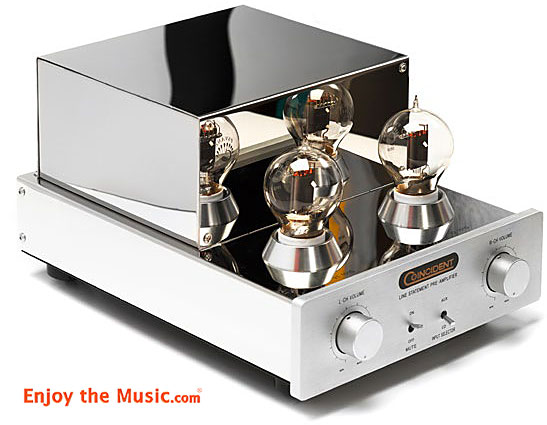
Statement Mk III Line Stage -
As of April 30/ 21, Coincident is introducing the new and improved MK.III version of the world renowned and award winning Statement Line Stage. The improvements include:
- State of the art 33 step volume potentiometers replacing the previous 23 step.
Not only will this result in noise free lifetime operation, it will provide greater control of the volume gradations which will now be .35 db versus the previous .7 db.
- Improved volume transformers to accommodate the new volume potentiometers.
- Higher energy storage power supply capacitors. Every capacity will have their voltages increased 40%.
- Closer matching for all resistors and capacitors.
The sonic result is a line stage that is noiseless, with the absence of any discernible signal alteration. The glory of music is reproduced as it was created.
Price:$6499 US

Coincident Statement Phono Stage
Coincident M300B MKIII Frankenstein Amps
Coincident Dynamo MKIII Amplifier


EnjoyTheMusic.com Blue Note Award 2020

August 2020
Enjoy the Music.com
Coincident Dynamo SE34 MK III Vacuum Tube Int. Amp.
A tube amplifier that is true to the master tape with soul.
Review By Tom Lyle
Back in March 2016, Enjoy The Music's Rick Becker reviewed the previous incarnation of this vacuum tube stereo amplifier, the Dynamo SE34 MK II. It was bestowed Enjoy the Music.com's 2016 Blue Note Award, and so, I suppose the best thing I could do would be to read Rick's review, and simply tack on an addendum, adding my thoughts on the differences between the two. Even though Rick Becker is an excellent high-end equipment reviewer, without listening to the older Dynamo 34SE MK II, I would feel more than a bit uneasy making any assumptions about how the MK II would sound in my system and listening room as compared to the MK III. Of course, I trust Rick's description of the older model, but I think I'll wait until I finish writing my review before reading his review.
The President of Coincident Speaker Technology, Israel Blume, says that the older Dynamo MK II's success was "overwhelming". He took this amplifier and made significant upgrades to it, including but not limited to improvements to increase its reliability, but more importantly, eliminate any noise, hum, and susceptibility to the AC line.
Wired
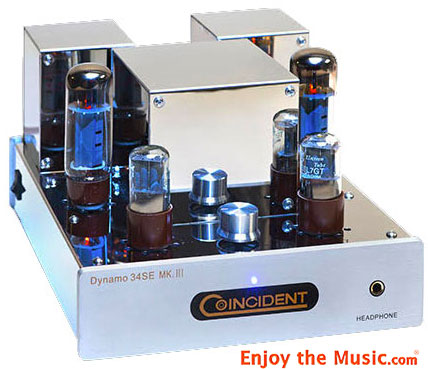
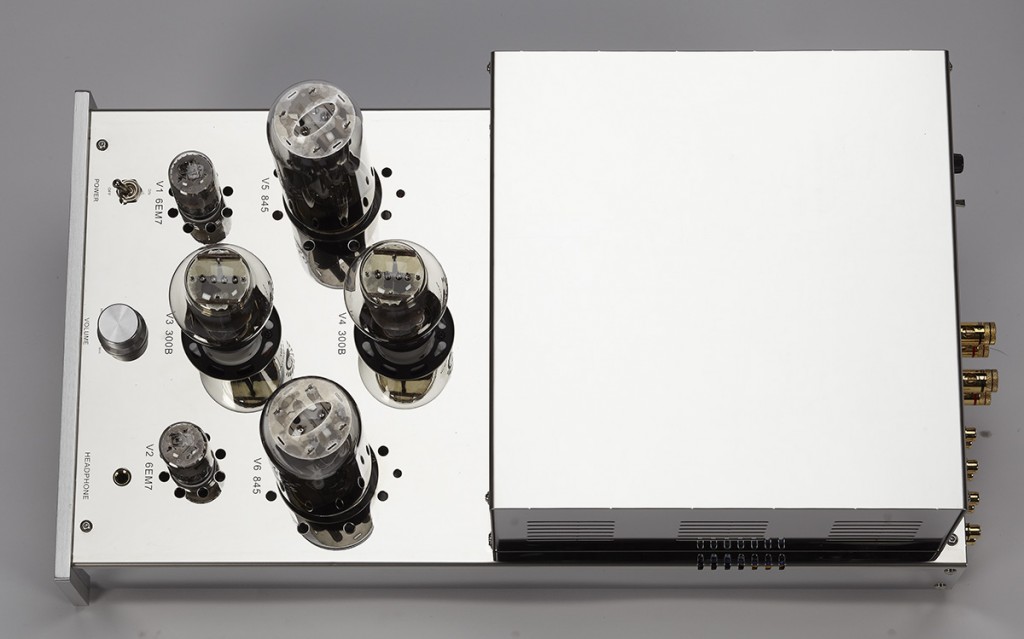
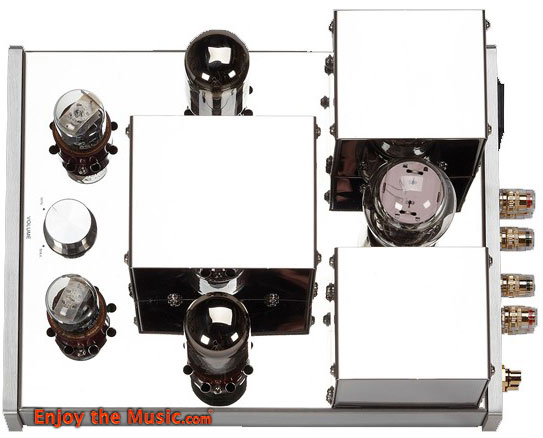
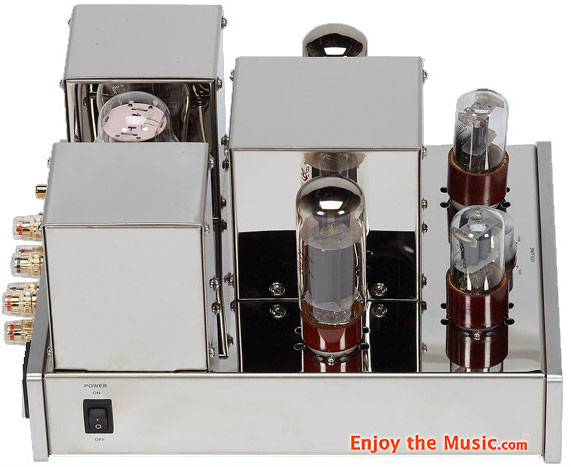
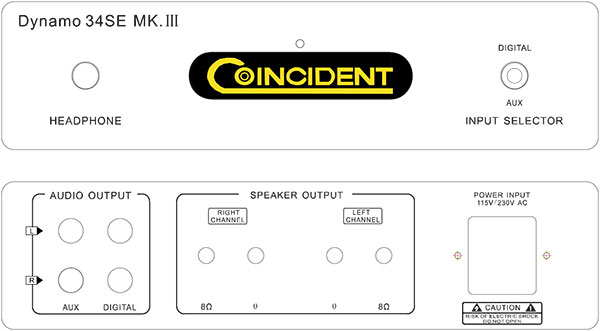
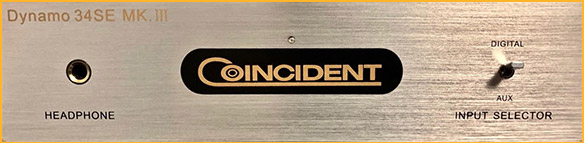
The Coincident Dynamo SE34 MK III is a low-powered, vacuum tube integrated amplifier that uses two EL34 pentode tubes wired in a triode configuration that runs in Class A. Its output power is 8 Watts per channel, it has inputs for two sources, and has a headphone input on its front panel. The only controls on the amplifier are a volume knob and a toggle to switch between the two inputs. The Dynamo SE34 MK III has no remote.
With that said, this is an integrated amplifier that some will be very interested in, and some will not be able to even consider for many reasons, mostly because its low power will not be able to drive their speakers. However, even if one has never considered a low-powered amplifier for use in their system, one might be surprised at how little power one needs to drive the average speaker system. Smaller speakers, such as many two-way stand-mounted monitors, and even some larger floorstanding speakers might be able to use a low-powered amp, as long as the speaker's impedance rating is not too challenging.
Many
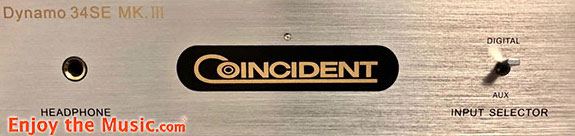
The improvements made to the Dynamo SE34 MK III integrated amplifier are many, so there are plenty of reasons to upgrade from the MK II version to the MK III of this amplifier. The Dynamo SE34 MK II was, according to Israel Blume, "an overwhelming success". Given that Rick Becker purchased his review sample should give weight to this statement. The most notable upgrade to the new model is that it now features two inputs that are selectable via a toggle switch on the silver, mirror-like finished of its front panel. And so, even though its preamplifier is passive, the Coincident Dynamo SE34 MK III is one that I truly consider an integrated amplifier.
The Dynamo MK III's power supply's transformer is 50% larger than its younger sibling, with better insulation and winding techniques, which Mr. Blume says "results in noiseless operation and a 40% reduction in generated heat levels". Its larger power supply is now isolated for its input circuitry. This improvement has the potential of eliminating EMI (electromagnetic interference).
The Dynamo MK III also has a 70% increase in the amount of filtering and energy storage available, which has the potential of producing deeper and tighter bass and will be able to match with a greater range of speakers with less effort. Its distortion levels have been reduced, especially in its low frequencies when playing the amplifier at high volume.
The new chassis of this integrated amplifier is 20% larger than its predecessor. It had to be made larger because of its new, larger power transformer, but the chassis also has been made more rigid, lowering the amount of unwanted resonance. The Dynamo MK III weighs eight pounds more than the older unit. Every capacitor in the Dynamo MK III has twice the amount of voltage capacity, and its tube rectifier has been upgraded from a 5U4GB to a soft start 5AR4. These, plus all the other improvements made to the very successful older component are significant. With all these improvements and features, many will be very surprised that the Coincident Dynamo SE34 MK III sells for an affordable price of $1799.
House
I used the gorgeous looking Coincident Dynamo SE34 MK III integrated amplifier in my second system located in a common area of our house. When I began to set up this system way back when, I used this system to test less expensive equipment, rather than in my larger system in my dedicated, acoustically treated dedicated listening room. Over time, the equipment in this system became better and better and now is made of equipment that is more in the "mid-priced" category.
The specifications of the EgglestonWorks Isabel Signature speakers I used for this review have only an average rated efficiency of 87dB/W/m. What makes these speakers appropriate for use with this low-powered amplifier is their very stable 8-ohm impedance rating. They are two-way floor standing speakers that I've used for both higher power tube and solid-state amplifiers and low-powered tube amps. The speakers played well with the Dynamo MK III and seemed to bring out the best in not only the amplifier but the music I played.
The analog front-end of this system I used to audition the Coincident Dynamo SE34 MK III consisted of the Pro-Ject X2 turntable and was fitted with an Ortofon Windfeld Ti phono cartridge. The phono preamplifier was a Chord Huei, which I reviewed earlier this year. The digital front-end used an Oppo CDP-83 Special Edition universal disc player and a Logitech Squeezebox Touch music streamer, both connected to either a Benchmark DAC3 HGS, but more often an Audio Analogue AADAC digital-to-analog converter that I also reviewed recently. Besides sounding excellent, the AADAC had the convenience of a remote-controlled volume, and also a very modern Bluetooth receiver, which was an excellent way to listen to music off-axis.
Connected
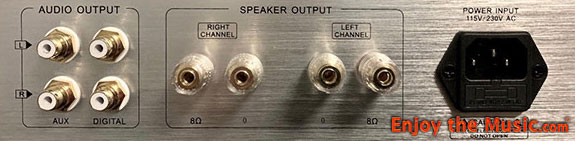
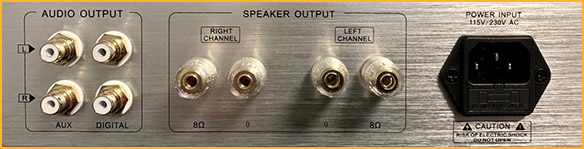
Setting up the Dynamo MK III was super-simple (as you probably have noticed, I will often call the Coincident Dynamo SE34 MK III stereo integrated amplifier the Dynamo MK III). I connected the DAC's analog output to the integrated amp's input labeled "Digital" and the analog output of the phono preamp to the amp's "Aux" input. When listening to digital, I frequently left the volume control on the Dynamo MK III on full and used the DAC's volume control, or sometimes would use the volume on my iPhone or tablet when I was listening to Tidal or other streaming services.
Selection
From the first selection to the last, I was very impressed with this component. Regardless of what type of music I played through the Dynamo, even though this was a true Class A tube amplifier, it wasn't tough to tell that this amp had a frequency response that was only limited by what was on the recording or my speakers, not by this amplifier. No, I wasn't listening to speakers that had unlimited low-frequency response, but I had never, not with any other amplifier that I've ever used in this system, low-frequencies that sounded this deep coming from these speakers. As a rule, I use a subwoofer when using these speakers, but did not need to connect it during the time the Dynamo MK III was here.
The bass coming from my speakers did not sound like it had an unnaturally pumped up mid-bass. I did not bother measuring the bass response, that's not something I would ever do, but if the mid-bass was inflated, it did not sound like it was. It sounded like music. It sounded like a relatively powerful, pitch specific, deep bass coming from the instruments that had low-frequency energy in this frequency region. Given that this amp is set up as a single-end, triode, Class-A amp, one would expect its midrange to be excellent sounding, and they'd be correct. It was as if I was not hearing a great stereo system, again, I was hearing music!
I was about a month into the review period, reveling in the sound of the Dynamo MK III, playing album after album of what I consider great music, including when I cranked the volume up on the Classic Records 200-gram "Quiex" pressing of Led Zeppelin III. This album alternates between hard-rock tracks and those that mostly use acoustic instruments. The Dynamo MK III was able to handle every note that was encoded into the grooves of this LP or into the digits of the high-resolution files I also spent some time playing. Side one of this album is dominated by the epitome of the era's hard-rock, on tracks such as "Immigrant Song", "Out On The Tiles", and especially "Since I've Been Loving You", a version of blues-rock that Led Zeppelin perfected during this era of their career.

I had a chance to speak to Coincident Speaker Technology's Israel Blume soon after listening to this Led Zep album. I was blown away by how it was able to handle this album so well, and especially my decision to turn up the volume to what I consider "realistically loud" when listening to it. Mr. Blume told me that the reason why I was enjoying the Dynamo MK III so much was that this 8-watt single-ended-triode amplifier had no problem driving the 87 dB sensitive EgglestonWorks Isabel Signature speakers to these high SPLs without distortion and compression. This was because of the massive size of the Dynamo MK III's power supply transformer and oversized power filter capacitors.
In my system, I've used amplifiers with more power than this integrated amplifier, but because of these oversized power filter capacitors, it has a greater amount of energy storage, which makes it have more headroom or power reserves that are available to power a given speaker. The Dynamo MK III's higher rating will be more resilient in avoiding clipping distortion and will have the ability to provide greater headroom (the difference between the signal peak levels and the amplifier's clipping level). Peak power depends on the amplifier's power supply, in other words, its energy story. If the amplifier's power supply has a bank of large filter capacitors, it can store energy that can be released during short peaks and avoid clipping or distortion.
It helped that the sound quality of the Classic Records' pressing of this album allowed me to hear much more of these elements than a "normal" pressing, at least as much, or more than when listening to the high-resolution digital file. There was a near-perfect separation of the instruments and voices that I wasn't expecting, and a dynamic distance placed between them that added to the sense of realism when playing this album. Even though it is well-known that there was some manual panning of the drum kit's toms, giving some listeners the impression that the toms were placed wider than they were when recorded when Bonham was traveling from one end of the drum set to the other.
But that's not what I mean by the Dynamo MK III separating the sound of the drums via their dynamic distance. The dynamic distance was exhibited when different drums and cymbals were played at nearly the same volume and were located in the same location in the soundstage, but there was still a natural amount of separation between each of these sound, and in addition to that, the amount of force that was applied during each drum and cymbal hit was more noticeable than I was accustomed to hearing. This dynamic distance is one of the characteristics that come with powering a high-end amplifier with tubes. And the Dynamo MK III displayed this trait magnificently.
Not only did the drums sound mega-realistic when played through the Dynamo MK III, but all the instruments and vocals on this track sounded wonderfully realistic, too! Spinning "Since I've Been Loving You" is a powerful track regardless of the equipment used to play it. But when heard through a high-end audio system in can be transcendent. But I would have never thought that it could sound this good using only 8-Watts of power through two-way speakers and without a subwoofer. Wow.
As mentioned above, in the system that I performed an audition of the Coincident Dynamo SE34 MK III stereo integrated amplifier displayed the traits of not only a good low-powered amplifier, but the traits of a good amplifier, period. Of course, I'm lucky that I had a pair of speakers that were able to take advantage of the Dynamo MK III's positive traits. This hand-wired amplifier, with its huge capacity power supply, oversized output transformer that uses high-purity medical grade copper windings, polypropylene coupling capacitors, and 50% over-rated all electrolytic capacitors, and has an auto-bias circuit all contribute to a sound that I considered jaw-dropping.
Proto
When most people hear Iggy Pop's name mentioned, they usually think about his time fronting the proto-punk band The Stooges in the late 1960s to the early 1970s. Or perhaps they might think of a more modern appearance on video, where he would flaunt his very muscular middle-aged physique. Lately, I've been playing many of the solo albums that he recorded in the late 1970s to the mid-1980s. He produced many good albums during this period, in particular, the 1979 album he released on Arista Records, New Values.

I have choices when playing this album, either CD, the file ripped from this CD that resides on my hard-drive that I can access through my home network, my original LP pressed by Arista that I purchased long ago, or my latest vinyl acquisition of this album on the Music On Vinyl reissue label, which was likely remastered from a high-resolution digital file. Either one of these sounded great through the Dynamo MK III, but the only that sounded the best was this new vinyl reissue.
Regardless of which format I played, what I heard when playing this album, especially when listening to my two favorite tracks, "I'm Bored", and "Five Foot One", featured, among a host of other positive characteristics a relatively clean, tight electric bass guitar sound thanks to none other than Jackie Clark, who some might remember from appearances on many Ike & Tina Turner records from earlier in the decade.
I'm also happy to report that I was getting accustomed to hearing a very transparent midrange from this amplifier, which not only brought out Iggy's vocals into my listening room but highlighted the very decent recording done at the Paramount Recording Studios complex in Hollywood. Once again, I heard crystalline, impressively extended highs, most of them coming from the cymbals of German drummer Klaus Krüger, who had just finished working with the genre antithetical Tangerine Dream, and a few years after recording with Iggy Pop stepped out even further into the ether with an album of experimental electronic music.
During the writing of this review, it was just about when I was listening to the Iggy Pop album when I felt as in my listening notes if I wasn't being 100% truthful about this amplifier's sound. Even though I praised this amplifier in many areas, and even praised it not as a tube amplifier, but a great amplifier regardless of how it was powered. When listening to the Iggy Pop album it made me feel as if I should admit that this amplifier sounded nothing like the more squeaky-clean sounding solid-state muscle amplifier that I've been listening to with this system of late.
But this might have been that I had become so accustomed to its "honest" sound, one that made it seem as if I was hearing exactly what everyone involved in making the Iggy Pop recording meant it to sound like. In addition to accurately reproducing the sounds that it is fed from the front-end of my system, the Dynamo MK III amplifier took what it "heard" from Iggy's full band, which besides bassist Jackie Clark and drummer Klaus Krüger, had on guitar Iggy Pop's old bandmate from The Stooges James Williamson, and also on guitar and keyboards Scott Thurston, who was also in The Stooges, but nearer to the end of their career.
This amplifier was able to present this album as one that seemed as true to the master tape as technologically possible, at the same time exhibited that it has a soul, reproducing the music on the album as an organic whole. This very important characteristic didn't jump out at me until I listened to a portion of New Values once more, this time connecting the 150-watt-per-channel solid-state Audio Analogue Maestro Anniversary integrated amplifier that I recently reviewed, but still had in-house because after that review I also reviewed this manufacturer's matching DAC.
I often describe this "organic" trait as one that sounds like music, or perhaps more accurately, lets me into the heads of the musicians and those responsible for producing the recording. This amplifier reproduced music as if it intimately knew the material that it was reproducing. That is a description as far from one that interprets the measured specifications of a component as I can think of. And in a nutshell, this is what this amplifier is all about. The music.
Background
Also, the Dynamo MK III had a dead quiet background. No hiss, no hum, no nothing. These days, I kind of expect at least a bit of inharmonious sound in the background of a tube amp. But the Dynamo MK III proved that an audiophile does not have to put up with even a little noise to enjoy the benefits that come with vacuum tube sound. Yes, this amp is heavy, and quite a bit of heat comes from the tubes that adorn the open chassis of this amplifier. But to have an amp with so many of the benefits of tubes without having to deal with noises that are not part of the music are over. That is, at least when listening to the Coincident Speaker Technology Dynamo SE34 MK III stereo integrated amplifier.
Device
Since I'm one to use either a portable device when listening to headphones or a relatively high-priced headphone amplifier (the Pass Laboratories HPA-1) I wasn't expecting too much from the headphone output of the Dynamo MK III. I was wrong. I think I'm going to have to reveal that president Israel Blume might be missing an opportunity. He could repurpose this amplifier as a headphone amplifier, and I bet it would garner many good headphone amplifier reviews! The sound I got from my headphones, whether I was listening to the relatively affordable Grado SR-325e or the quite expensive OPPO PM-1 planar magnetic headphones, or the undeniably expensive Grado PS-2000(e), I could easily use the Dynamo MK III as my reference tube headphone amplifier. I would rate this headphone amplifier in the level of a tube headphone amplifier that normally sells for $1000 to $1500... or perhaps more.
This is a powerful sounding headphone amp – it was full-bodied, had an impressive amount of frequency extension, and had a well-focused sound. It was particularly transparent sounding in the midrange, which wasn't at all surprising since that is the sonic signature of the amp when used through my speakers. The bass was more pronounced when using speakers, but I'm picking nits, because of the quiet background that I heard when listening through the headphones made up for this, big time.
The only disadvantage of using headphones with this vacuum tube stereo amp is that when plugging into the 1/4" jack on its front panel does not automatically disconnect the speakers. The reason for this might be that when designing a sonically sensitive amplifier such as the Dynamo MK III, putting more circuitry in the path of the musical signal is something that is to be avoided. Although, to me, this might be a price I'm willing to pay given how much a pain in the butt it is to disconnect and reconnect my speakers. Your mileage may vary, so I might be making more of this than I should, as this is something others might not feel is as much of a burden as I did.
Admit
I'll be the first to admit that high-end audio can be an expensive proposition. But it doesn't have to be. A case in point is the Coincident Dynamo SE34 MK III integrated amplifier. In the past, I've used many different amplifiers with the same system I used to audition the Dynamo MK III, both tube and solid-state, both high and low-powered. If I was forced to spend the rest of my days with this integrated amplifier, powering the speakers I used for this review, I'd have no problem with this. If one has or can somehow acquire speakers that can work well with a low-powered amplifier, I highly recommend the Coincident Technology Dynamo SE34 MK III. And if one is already using the MKII version of this amplifier, I highly recommend upgrading to the MKIII version.
Tonality |
 |
Sub–bass (10Hz – 60Hz) |
 |
Mid–bass (80Hz – 200Hz) |
|
Midrange (200Hz – 3,000Hz) |
|
High Frequencies (3,000Hz On Up) |
|
Attack |
|
Decay |
|
Inner Resolution |
|
Soundscape Width Front |
|
| Soundscape Width Rear | |
| Soundscape Depth | |
Soundscape Extension Into Room |
|
Imaging |
|
Fit And Finish |
|
| Self Noise | |
Value For The Money |
|
Specifications
Type: Vacuum stereo integrated amplifier
Inputs: Two stereo RCA, front panel selectable
Output Power: 8 Watts per channel, two channels
Tube Compliment: Two 6H9C (6SL7) input/driver tube, two EL34 output tube, and one 5AR4 soft-start rectifier
Output impedance: 8 Ohms
Frequency Response: 20 Hz to 20kHz
Sensitivity: 300 mV full output
Input impedance: 100 kOhms
Headphone Amplifier Output Impedance: 100 Ohms
S/N Ratio: 92dB
Weight: 30 lbs
Dimensions: 9.5" x 12.5" x 7" (WxDxH)
Price: $1799
Company Information
Coincident Speaker Technology
391 Woodland Acres Crescent
Maple, Ontario
Canada L6A1G2
Voice: (647) 221-1834
E-mail: iblume@coincidentspeaker.com
Website: www.CoincidentSpeaker.com
May 2020

We Ask 10 Questions For High-End Audio Manufacturers
Featuring Israel Blume Of Coincident Speaker Technology
Enjoy the Music.com's 25th Anniversary brings you a new special feature!

During Enjoy the Music.com's very special 25th Anniversary we're asking various high-end audio manufacturers to answer the same ten questions. Their answers may surprise you! This month we're featuring Israel Blume of Coincident Speaker Technology. Coincident Speaker Technology was established by Israel Blume in 1993 for the sole purpose of creating a superior loudspeaker. Mr. Blume was ultimately dissatisfied with every loudspeaker he had ever owned or listened to. From the Quad ESL 63 to the Martin Logans, to Wilson Watts and almost everything in between exhibited sonic weakness that proved to be in the long term unacceptable.
Blume put his over twenty five years of audio and music experience to work to conceptualize a loudspeaker that would reproduce music with no obvious or distracting perversions. He understood quite well the inherent limitations of electrostatic designs, i.e. the need for a signal contaminating high voltage step up transformer, its low sensitivity and large size et al. At the same time virtually all dynamic systems possessed their own set of compromises, namely, slow transient speed, small image size, etc.
The theoretically perfect audio component would sound like nothing. It would simply transmit the signal it is being fed with no alteration, enhancement, subtraction or distortion. Our goal with all Coincident models is for them to pass as much musical information with the least possible coloration. Coincident speakers do not editorialize or attempt to glamorize the sound. For example, there is no intentional boosting of the midbass to provide the illusion of more bass, nor the rolling off of the high frequencies to make the resultant sonics more pleasing. Coincident Speakers are designed to be as musically accurate as possible.

Q. What is your first memory of falling in love with music?
A. The day my parents purchased a Fleetwood all in one record player. It resembled a piece of luggage with the top portion opening up to reveal a record player. My older brother bought a few records. The first 45 he played was Dusty Springfield singing "I Only Want To Be With You," followed by "She Loves You". I was hopelessly hooked.
Q. How did you first get introduced to high-fidelity audio gear?
A. My passion for high end audio was ignited when during my first year of university in 1972; I started working in an audio store. I came across an amp and a preamp and I questioned why two components were necessary when a receiver performed the same function. I listened to these-separates playing Bad Company, an LP I had heard countless times. But never like this! That was it. My passion for audio was transformed to a virtual obsession. That revelatory experience changed my life forever. It was always about the love of music but now the hardware became its harbinger to deliver the musical message more convincingly and at a significantly enhanced level.
My first audio system purchased in 1973, consisted of Luxman M75 power amp, Luxman CL-35 preamplifier, Acoustique 3A Master Control speakers and a Micro Seiki turntable.

Q. What is your favorite piece of vintage hi-fi, and why?
A. The Luxman CL-35 preamp. Since it was my first high end component and it being tubes which convinced me that tubes reproduce the fundamental harmonic structure of music that solid-state, to this day, cannot replicate.
Q. When did you decide to start a high-end audio company?
A. During college and afterwards, high-end audio was my passion. I started to import some high end gear for distribution in Canada as well as offering system set up and component upgrades and modifications. I then had a customer who brought me a reference quality speaker that was very expensive and raved about by the reviewers and consumers alike. Yet he was disappointed in its performance and asked me to see if I could improve it. After removing the drivers and disassembling the crossover, I was shocked by the inexpensive, inferior drivers being used and the poorly designed overly complex crossover utilizing very cheap and poorly sounding components. I replaced all the drivers, and redesigned the crossover using state the art components. The end result was revelatory. The customer was so thrilled, word quickly spread and I became inundated with other owners requesting the same upgrade. That's when I decided to start my own speaker company.
Q. What, and when, was your company's first product?
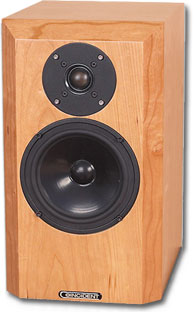
A. Coincident Speaker Technology was born in 1994. Our first product was the Triumph speaker. It was a two-way bookshelf speaker conceptually very similar to the model I had so successfully modified yet at a fraction of the price.
Q. What challenges did you face during those early years?
A. Numerous. Being an unknown with a company and products that were new to the industry with very little marketing budget is a daunting endeavor ripe for failure. Audio stores were not willing to take on a speaker model that they would have to market in order to compete against well-known and established brands.
Q. How have your products evolved over the years?
A. From the initial model, a floorstanding version was introduced. Both speakers quickly carved out a niche in the audio market place due to superior build quality and performance at a fraction of the price of the competitors. Annually more models were introduced until we covered most price points and performance categories. Coincident cables followed and ultimately our own electronics completed the goal of a complete Coincident audio system.
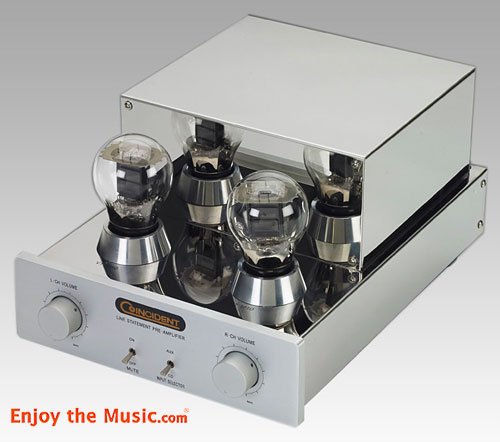
Q. What is your company's most popular product(s)?
A. Our Statement Line Stage and Frankenstein M300B mono amplifiers which are a challenge in satisfying demand. However, the Statement Phono Stage and Dynamo MKIII amplifiers are still very popular.
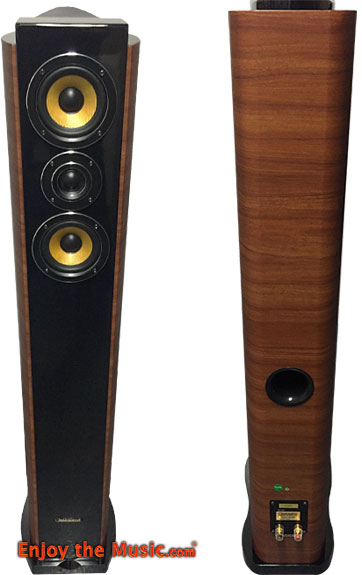
Q. What is your next planned product offering and its' features?
A. At this time, there are no concrete plans for any new model introductions as keeping up with current demands is highly challenging.
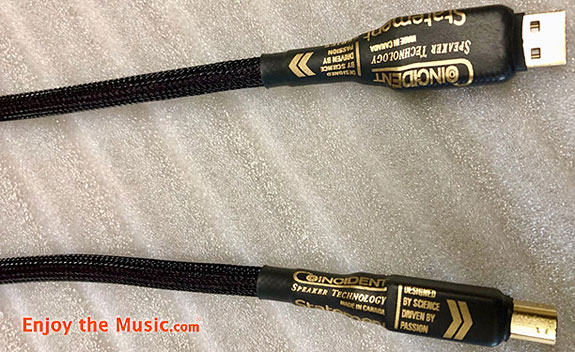
Q. What advancements do you speculate high-end audio will offer ten years from now?
A. Components that are simple and convenient to use, that augment the decor of the environment in which they are placed. They will be wireless and highly intuitive.
Manufacturer
Coincident Speaker Technology
391 Woodland Acres Crescent
Maple, Ontario
Canada L6A1G2
Website: www.coincidentspeaker.com
|
Dynamo 34SE MKIII
|
Editors Choice
The Absolute Sound |
 |
|
Frankenstein
M300B Mk. II |
Editors Choice
The Absolute Sound |
|
Super Victory III Loudspeaker. Coincident Speaker Technology is very excited to announce the introduction of the Super Victory III . What makes this speaker so special is that it offers state of the art design, construction and performance in a compact, aesthetically pleasing form that is priced far below what one would expect to pay for this high level of achievement.
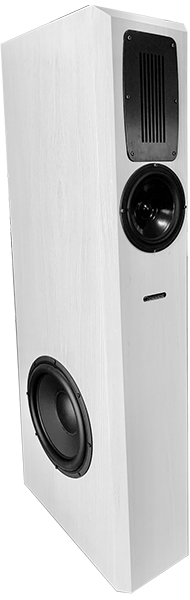
The Super Victory III will sound superb in small to moderate size as well being highly capable of easily filling a large space. They can be positioned as close as 18” from a back wall without suffering the deleterious sonic affects of reduced front to back depth. Their high sensitivity, smooth 8 ohm impedance modulus, simple first order crossover, phase coherency both acoustically and electrically all ensure that SET 300B, 211 or even 2A3 tube amplifiers will mate optimally. The Super Victory III high power handling capability will mean that large power tube and solid state amplifiers will also work beautifully for audiophiles who favour those types of amplifiers. As always with Coincident speakers, amplifier choice is a personal one.
Improving upon the award winning (Stereomojo Speaker of the Year, Best Medium Speaker at CES, TAS Editor's Choice Award) Super Victory is no easy task, but the new Super Victory III has done just that. All the drivers- Tweeter, midrange and woofer are new and dramatically improved. The improvements are as follows:
1. Tweeter- Latest evolutionary improvement to the ribbon tweeter technology used in previous Total Victory and Super Victory designs. Less mass and improved neodymium magnet structure results in wider dispersion, greater dynamic capabilities and even airier, more extended high frequency response.
2. Midrange- The latest composite cone technology results in a stiffer, lighter cone which reduces distortion at high SPLs by 35%. Magnet mass has been increased by 50% which translates to greater sensitivity and wider frequency response.
3.Woofer- The latest developments in state of the art woofer design has now been incorporated into the SV III. The new unit is based upon the previous one but the cone material has been changed from Nomex to aluminum. The sonic result is higher output capabilities and reduced distortion levels at the lowest frequencies. Response down to 20 hz with distortion at high SPLs at vanishingly low levels. The finest woofer available and the same unit used in our state of the art Pure Reference Extreme MK II loudspeakers.
4.Crossover- Due to the above changes, the crossover has been further optimized to take advantage of all the improvements incorporated in the SVIII.
The Super Victory III has taken a breakthrough product and the finest value in speakers and made it better. All the sonic attributes that made the Super Victory world renowned have been retained and enhanced to a significant degree.
Specifications:
Sensitivity: 92.5 db -1 w@ 1 M
Impedance: 8 ohms
Power Requirements: 3 watts - 500 watts
Frequency Response: 22 HZ - 35 Khz
Dimensions: 47" H x 9" W x 19" D
Weight: 125 lbs ea.
Price: $11499 US/pr.
The Dynamo MKIII is now available on special order optimized for 300B output tubes instead of the EL 34 which is still standard. The Dynamo MKIII will now exhibit all the finest sonic qualities of single ended triode 300B output. Compared to the Dynamo SE34, power output remains the same. Gain is slightly lower which is especially well suited for high sensitivity loudspeakers. The new Dynamo SE 300B MK III will easily exceed the performance of comparable SET amplifiers costing many times its reasonable selling price. For those wanting to buy the M300B Frankenstein amps, but require something more compact in a single chassis with a state of the art headphone amp and a line stage with 2 inputs, at a more affordable price, the new Dynamo 300B is impossible to equal.
Price- $2399US - without 300B tubes.
$2575 US- including tested and matched Psvane Clear Glass 300B tubes.
For owners of Dynamo MKII, converting your unit for 300B output operation, is now available.
Price: $699US without 300B tubes
$875US with Psvane matched and tested Clear Glass 300B tubes.
Announcing the Dynamo SE 34 MK III
After the overwhelming success of the Coincident Dynamo 34SE MK II amplifier ( Editor’s Choice TAS, Blue Note Award by enjoythemusic.com , Positive Feedback ) we are excited to announce the Dynamo SE 34 MK III. The MK III contains a whole host of significant upgrades that not only enhance performance but dramatically improves reliability, virtually eliminates noise, hum and susceptibility to AC line variation and fluctuation. The end result is taking the already breakthrough performance and build quality of the finest value amplifier in existence and elevating it to a new level of excellence in every parameter. The most noteworthy change offered by the MK III, is the introduction of 2 inputs selectable from the front panel. The improvements include the following:
1. Power Supply - The power transformer has been enlarged by 50%. Much improved
insulation and winding techniques result in noiseless operation, and a 40% reduction in
generated heat levels.
Filtering and energy storage has been increased by a whopping 70%. The sonic
improvement is substantial- deeper, more impactful lower frequencies, wider
and the ability to drive a much wider range of speakers without strain. Distortion levels
at high SPLs and low frequencies has been reduced by 35%. Furthermore, the large
power supply has now been isolated from the sensitive input circuitry resulting in the
elimination of electromagnetic interference.
2. Chassis - Not only is the chassis 20% larger in order to accommodate the huge new power transformer, it has been stiffened and braced to reduce unwanted resonances. Sonically this translates to greater purity and transparency. The Dynamo has gone from weighing 22 lbs to 30 lbs.
3. Capacitors - Every single capacitor has been doubled in voltage capacity which provides bullet proof reliability and eliminates potential problems in areas afflicted with high AC line voltage that is prone to surging and/ or fluctuation.
4. Tube Rectifier - The previously used instant on 5U4GB rectifier tube has been replaced with the soft start 5AR4. This provides a safeguard against excessive inrush current upon turn on.
5. Two Inputs - The MK III has now been transformed into a stereo integrated amplifier. Toggle switch selectable on the front panel are the 2 inputs.
The overall improvement wrought by the MK. III is highly significant. From virtually eliminating noise so that the Dynamo can successfully be used with ultra high sensitivity speakers and increasing its power capabilities so that it can mate with a wider range of lower sensitivity speakers to unshakeable reliability in any environment to stunning performance enhancements that include deeper, punchier bass, greater transparency and purity overall, more expansive soundstage and greater extension and air in the treble all combine to create an amplifier that while is hard to surpass at $5000, is unmatched at its value laden price of only $1799 US. While the Dynamo 34SE MKII at $1499 US was considered the finest value in all of high end audio, all the huge and costly improvements incorporated in the MK. III with only a $300 increase in price, make the even more of an audiophile bargain.
For those on a budget but who still demand top flight sonics and build quality, the Dynamo will prove to be a revelation. Single ended triode tube sound that belies its 8 watt power rating. Any 86 db sensitivity speaker can be powered with startling clarity and dynamics. Build quality not seen at twice the price. Perfect for those who want a simple compact set up or as a second system where true musicality is insisted upon. Hard to believe that this much performance and quality can be had for under $1800 US. Volume control and 2 inputs front panel selectable turns the MKIII into a stereo integrated amplifier obviating the need for a line stage and includes a highest performance headphone amp with phono jack conveniently located on front panel.
Features:
- All hard wired.
- Huge capacity power supply
- massive power transformer
- output transformers using 6N copper windings
- polypropylene coupling capacitors
- all electrolytic capacitors 50% over rated.
- state of the art headphone amp included
- high gauge stainless steel,mirror finish chassis
- auto bias circuit to automatically optimize tube performance
Specifications:
Inputs: 2 RCA - front panel selectable
Output Power : 8 watts per channel
Tube Compliment : 6H9C (6SL7) -2 input/driver tube, EL 34 (2) output tube,
5AR4(1)soft start rectifier
Output impedance : 8 ohms
Voltage selectable: 115V/230V - switch located on bottom plate
Frequency response: 20 hz- 20khz- flat
Sensitivity: 300 mv full output
Input impedance : 100K ohms
Headphone Amp Output Impedance : 100 ohms
S/N Ratio- 92 db
Weight: 30 lbs
Dimensions : 9.5” W x 12.5” D x 7” H
Price : $1799 US
|
|
|
Coincident Pure Reference Extreme Mk. II Speakers
By Arthur Salvatore - High End Audio
Introduction
The (2017) Mk. II update of the Coincident Pure Reference Extreme (PRE) speakers is a serious and important improvement over the original model (which I've owned for almost a decade). In fact, the overall extent, scale and scope of the sonic improvements, provided by the Mk. II, are unusually large, and hence requires more than just a simple and cursory description.
Accordingly, the review/essay of the PRE MK. II below is my best attempt to provide a thorough, useful and relevant perspective of these new models for both an original PRE owner, and for all current loudspeaker enthusiasts as well.
My History with the Pure Reference Extremes
The "original" Pure Reference (a single enclosure, now long discontinued) joined my system in late 2007. The "Extreme" (two enclosure) version of the Pure Reference, which I had incessantly lobbied for, replaced the original model in late 2009.
Later on, in Spring 2010, I "doubled up" the Extremes, by stacking a second pair of the PRE on top of the first pair. Finally, in Spring 2017, I added a pair of Acapella ION Super Tweeters. Each of these three changes, all of which provided serious sonic benefits, are well documented, described and discussed in my PRE essay linked below.
All during the 8 years of the PRE's existance (2009-17), a number of minor changes were made to the speakers. However, none of these changes were truly significant enough, even cumulatively, to actually cause a change to the model designation. Finally though, in Fall 2017, it happened. Coincident made an announcement that a new version of the (two-enclosure) Extreme was now available. It was designated by the manufacturer as the PRE "MK. II". For all the important details of my history with the PRE...
Here is a direct link to My Comprehensive Essay/Review of the Coincident Pure Reference Extreme Speakers. I highly advise reading at least part of this earlier essay to fully understand and appreciate this current review, which is (or will be), in reality, just an (important) "Addendum" to the original essay/review. (Example; The original PRE review discusses my entire personal loudspeaker history, going back to 1972, amongst many other subjects and issues addressed about speakers etc.)
Click here to read the full review
2019 TAS Editors' Choice Awards
|
Coincident M300B Frankenstein MKII Amplifiers
|
Editors Choice
The Absolute Sound |
 |
|
Dynamo Mk II
|
Editors Choice
The Absolute Sound |
|
Coincident Turbo 845SE Mono Amplifiers
25th Anniversary Limited Edition
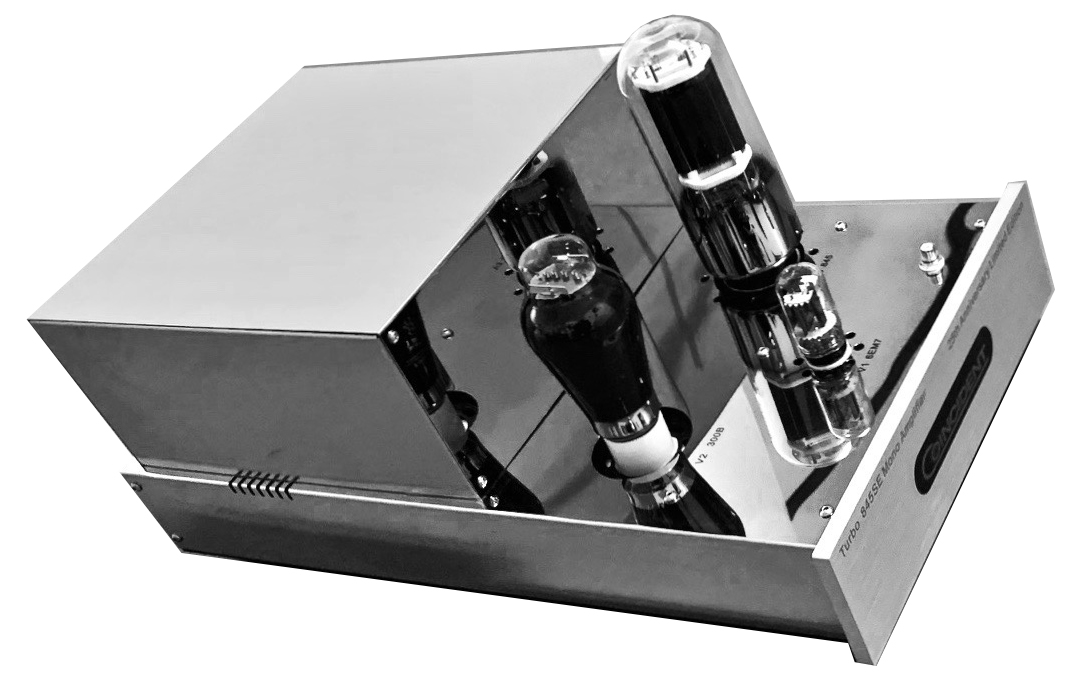
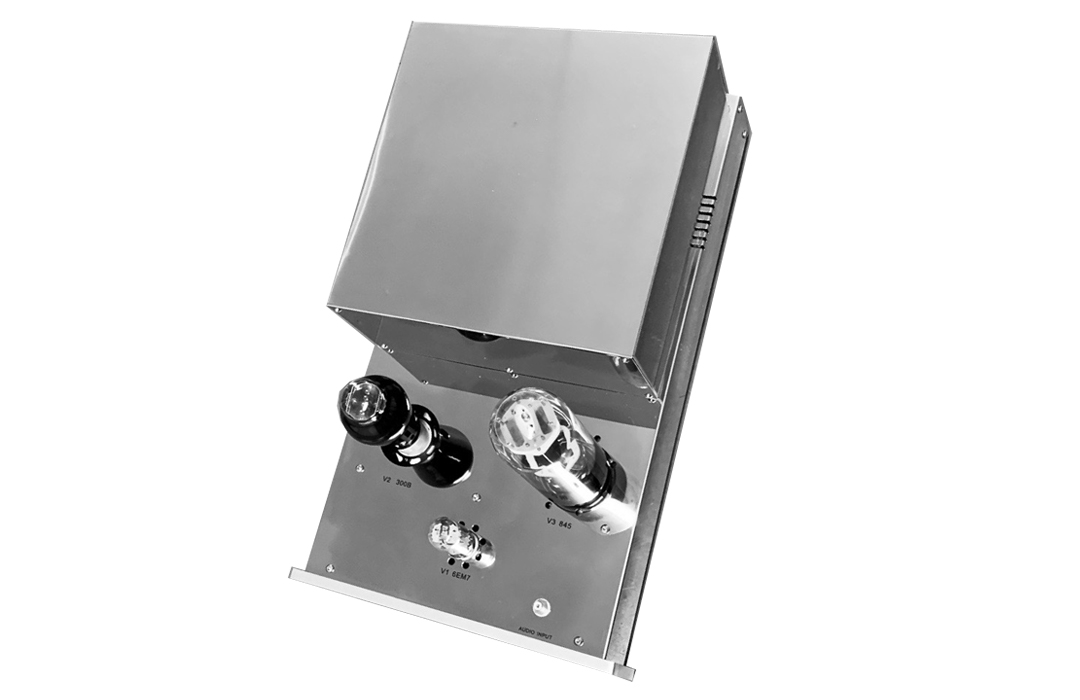
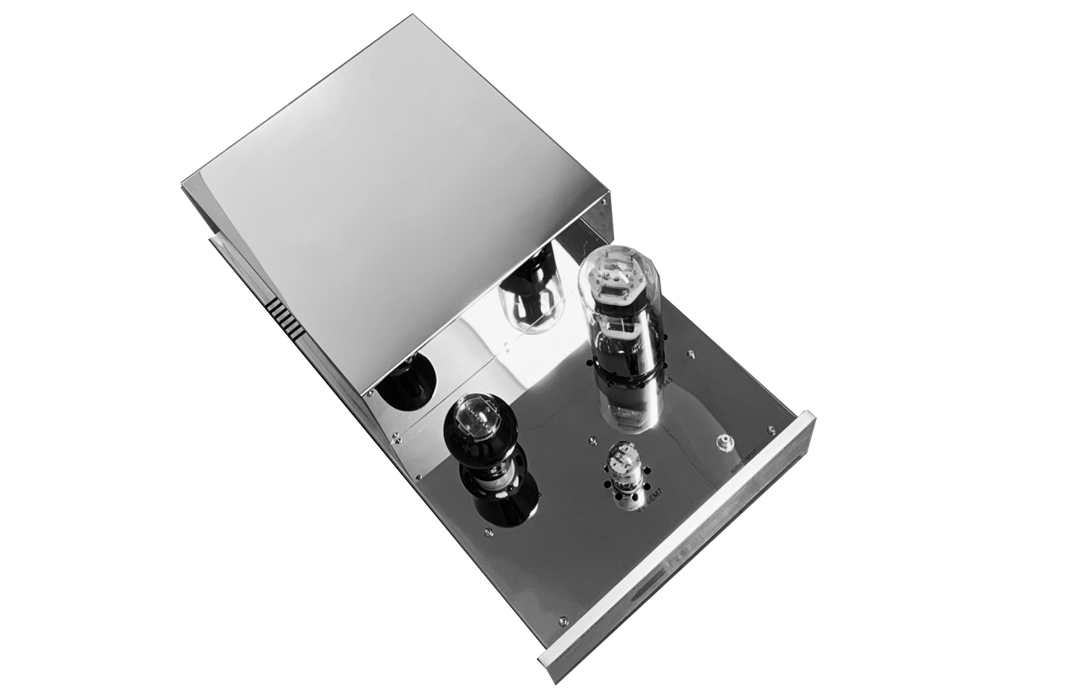
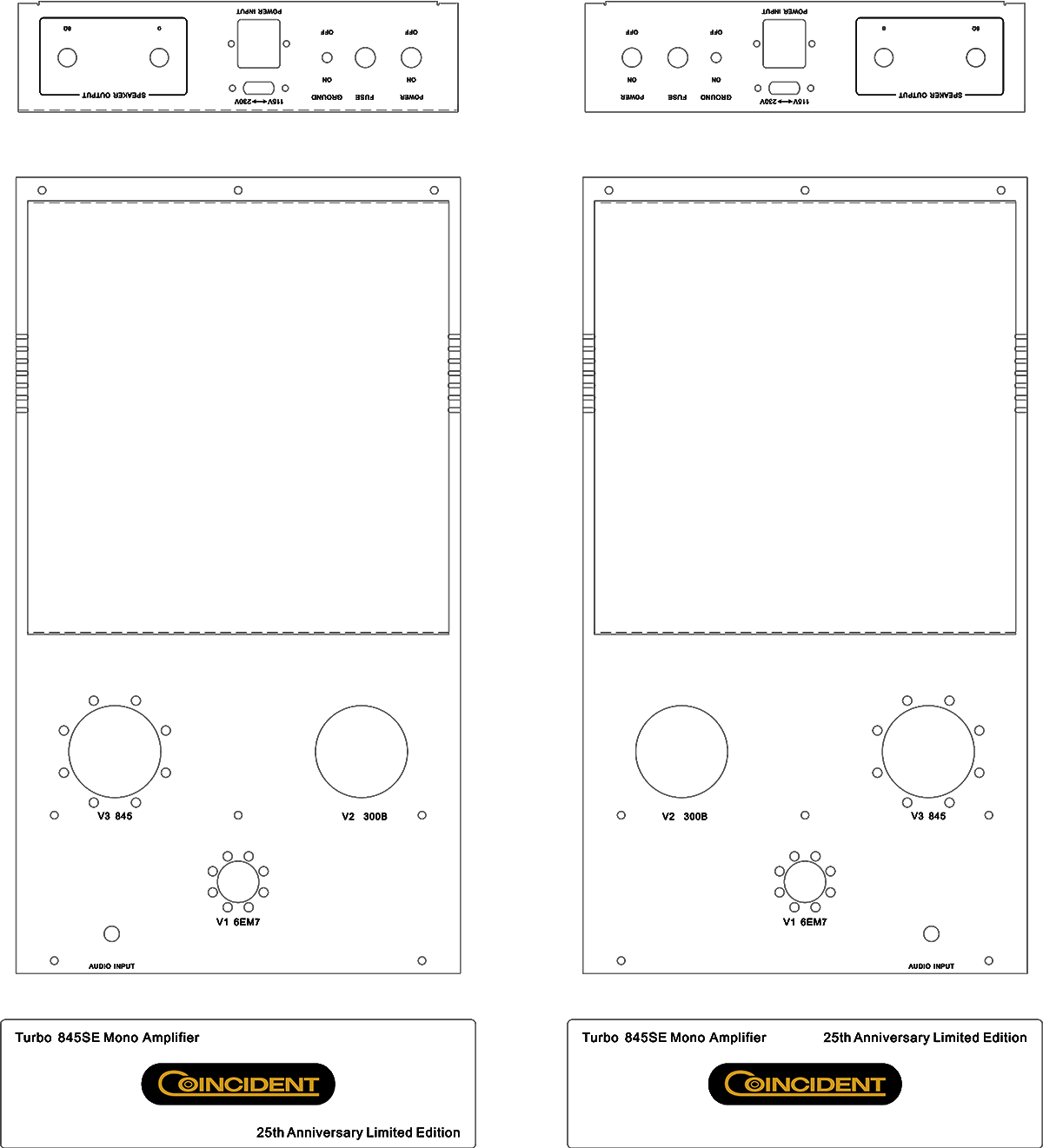
Coincident is thrilled to introduce a special, once in a lifetime audio component of unparalleled design, build quality and sonic performance. The Turbo 845SE - 25th Anniversary Limited Edition Amplifier is a celebration of the 25 years since Coincident was established. The Turbo 845SE is the culmination of more than 2 decades of painstaking research and development into all amplifier technologies and modes of operation. The goal - create the most transparent amplifier whose flaws are so negligible as to be essentially indiscernible and simultaneously be capable of driving virtually all high performing speakers. The result was single ended operation, using directly heated triode tubes- maximizing harmonic completeness, revelation of low level detail- coupled with power delivery that would not compromise real world dynamics, low bass extension nor diminish the impact, weight and authority experienced in a live music environment. These amplifiers were created with absolutely no holds barred, to be state of the art with no regard to cost. The Turbo 845SE Monos represent a breakthrough in amplifier performance. The Turbo 845SE Monos, remarkably, as all Coincident components, also represent the finest value in all of high end audio.
The Turbo Monos will be a limited edition restricted to the sale of 25 pairs. Once they are gone, there will not be any further offered for sale. They are destined to become a collector’s classic.
- High gauge stainless steel, mirror finish chassis that is non magnetic, extremely rigid and non resonant
- Dual power transformers per amp- High voltage and Low Voltage Filament- to ensure low noise, cool operation and unlimited power reserves
- The finest Ohno copper interstage (no coupling capacitor), output and dual power transformers
- Tube compliment- 6EM7 super tube for input- So much current capability it has its own power supply
- 300B Driver Tube for utmost purity ( no pentode tubes used in this DHT design)
- 845 Shuguang Psvane output tube in single ended configuration
- Only Teflon caps used in cathode bias circuit
- Massive power supply- caps are all 1500V polypropylenes- no electrolytics- Joule rating - 975- exceeds those in 600 watt RMS tube amplifiers - Provides tremendous peak power capability
- 28 watts RMS sounds like 100 watts due to extra large energy reserves
- Binding posts are Coincident Ohno copper, .25" solid post
- Ultra High precision auto bias circuit maintains optimum bias as tubes age
- All resisters are 1% tolerance and none less than 2 watts
- All meticulously hard wired using the breakthrough Coincident Statement cable
Due to the impeccable hand crafting, finest state of the art components, and massive power supply energy storage, (975 Joules), the Turbo Monos are not only the most accurate, transparent, harmonically complete, and full range SET tube amplifiers, they are fully capable of driving virtually any speakers of 84 db sensitivity or more to concert hall levels with ease. While rated at 28 watts RMS, peak levels of 100 watts is available with virtually no distortion or compression.
Specifications:
Output Power: 28 watts RMS - 100 watts peak-
Class A-
Energy Storage: 975 Joules
Output Impedance: 8 ohm
Frequency Response: 20hz-20khz ±1db
T.H.D.: <1%, 20hz-20khz (Ref. Output)
Input Sensitivity: 700 mv for full output
Input Impedance: 100k ohms
S/N: >90db
Tubes: (6EM7 ×1, 300B ×1, 845 x1) / Channel
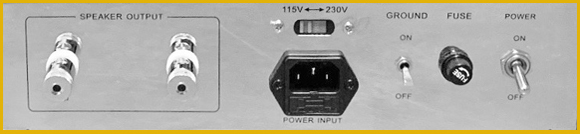
Power Requirement: AC 115v or 230V 50/60hz
(User selectable on
back panel)
Dimension: 12 “ W x 21 “ D x 10 “ H
Gross Weight: 110 lbs - 41 Kgs
Net Weight: 98lbs- 44.5 Kgs
Price: $14,999 US /pair

|
|
|
|
|
|
As of Jan.15/19, Coincident is excited to introduce the MK.III version of the Frankensteins. Improvements include:
- Separate HT fuse which protects the amplifier in case of 300B tube failure
- Enlarged power supply capacity- deeper, more impactful bass
- Improved voltage regulation- immune to AC voltage fluctuations
- Improved resistors and capacitors which results in greater revelation of low level detail and airier, more extended high frequencies
- Coincident Statement internal wiring which enhances purity and transparency.
- Upgraded output transformers with a flat frequency response from 10 hz- 30khz.
The Frankenstein MK III are even more transparent, with extended frequency range, enhanced dynamics, punchier, tighter bass and are absolutely dead silent.Perfect match with ultra high sensitivity speakers ( 100db or higher) due to the total absence of residual noise.
The M300B Frankenstein MK III mono amplifiers are now in stock. Built to the absolute highest standard -
-Triangular chassis constructed from high gauge stainless steel -mirror polished finish- maximum non resonant, highest rigidity and non magnetic
-All hardwired with Coincident Statement cable
-The finest 6N copper interstage (no coupling capacitor), output and power transformers
-Finest Teflon caps
-Massive all polyproylene power supply- no electrolytics
-Precise Auto biasing which maintains optimum operating bias as tubes age
-3 tube configuration (6EM7 input driver, 300B output, 5U4GB rectifier) for purest sonics
-Input and rectifier tubes are the best NOS American. Comes standard with the finest quality, tested and matched Psvane 300B tubes. Others available at special
discount pricing
These amps represent a sonic breakthrough. Their transparency and absence of an electronic sound set new standards. Mated to the appropriate speakers, they will prove to be a revelation. They easily drive every Coincident speaker model.
MK III Specifications-
Output Power: 8 watts RMS -(Triode) / SE Class A
Output Impedance: 8 ohms- Optimized for 8-16 ohms.
Frequency Response: 10hz - 20khz ±1db
T.H.D.: <1%, 20hz-20khz (Ref. Output)
Input Sensitivity: 700mv
Input Impedance: 100k ohm
S/N: >90db
Tubes: (6EM7×1, 300B ×1, 5U4GB ×1) / Channel
Power Requirement: AC 115v Or 230V - 50/60hz (User selectable on back panel)
Dimension: 15" W x 12" D x 8.5 "H
Gross Weight: 19 Kgs- 41.8 lbs.
Net Weight: 17.5 Kgs - 38.5 lbs.
Price - $6499 US /pair

2018 Positive Feedback Writers' Choice Award
Dynamo Mk II Amplifier
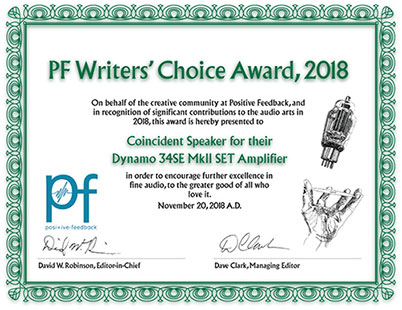
Coincident Dynamo 34SE MKII SET Amplifier
The first hint that I wasn't getting the best out of the 12 Ohm, 93dB efficient Triode Masters was when I replaced my 80-150-wpc solid-state amps with the amazing 8-wpc Coincident Dynamo 34SE MkII SET amp. I can't officially give the Dynamo an award as I didn't review it, just purchased it based on a friend's raves. Adding the Statement power cord on Coincident honcho Israel Blume's recommendation upped the performance so markedly I bought another cord for the Oppo 205. Which led me to buy one of their interconnects, each cable easily bettering what I had carefully and happily matched to the solid state amp/metal driver speakers in my previous rooms.
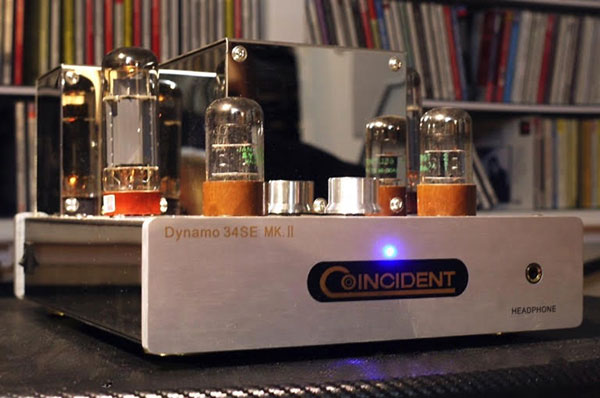

Dynamo Mk II
High-End Audio Buyer's Guide Award
Coincident Dynamo MK II Amplifier
Statement Mk II Line Stage -
As of Sept.15/18, Coincident is introducing the new and improved MK.II version of the world renowned and award winning Statement Line Stage. The improvements include:
- Upgraded volume potentiometers;
- Improved volume transformers;
- Higher energy storage power supply capacitors;
- Coincident Statement internal wiring.
Coincident Speaker Technology
Dynamo 34SE MK II Power Amplifier
Little Amp, Big Sound
By Dick Olsher, The Absolute Sound
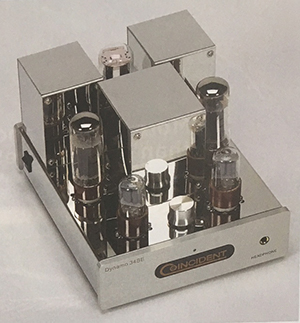
Since my initial review of the Dynamo 34SE in 2015, the amp has undergone several significant revisions. On balance, the Mk. II version of this low-cost SET amp ($1495, 8Wpc) should be thought of as nothing less than a Dynamo on steroids. For starters, it has put on some weight, tipping the scales at 30 pounds, an eight-pound increase from the original, due mostly to the beefed-up power transformer. The chassis has been upsized and properly braced to reduce resonances. The 5U4G rectifier is gone, replaced by a 5AR4, which by virtue of its indirectly heated filament provides for a gentle high-voltage start up. This is a good thing, and I'm happy to report that, unlike my experience with the 5U4G, the 5AR4 worked flawlessly. Power supply filter capacity has been increased by 70% and capacitor voltage ratings have been doubled for increased reliability. you get all this for only a $200 increase in retail price- now that's something worth writing about.

April 2018
Passive Versus Active Preamplifiers
Article By Israel Blume
President, Coincident Speaker Technology
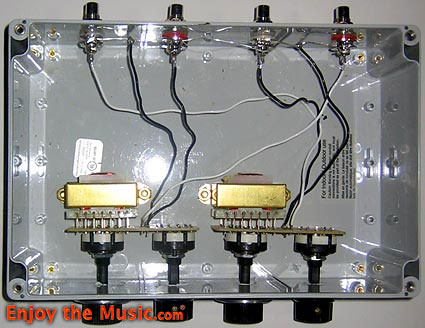
Passive Preamplifier
In essence is merely a volume control designed to attenuate the signal going from the source (usually a CD player) to the amplifier. Since it is passive, it has no inherent gain because it has no active components (tubes or transistors) in the signal path. The quality (sonic purity) will be largely dependent on the volume potentiometer used. The finest discrete resistor pots will sound more accurate than a variable one, for example, since the signal travels through only one resistor at any given setting and is therefore not dependent on volume position as is the case with a variable pot. Many believe that transformer volume controls can be superior to even the best discrete resistor pots, since the TVC is inherently passive while the latter still requires the audio signal to traverse a resistor. The TVC is more costly to properly implement since the best transformers are very expensive.
2018 TAS Editors' Choice Awards
|
Coincident M300B Frankenstein MKII Amplifiers
|
Editors Choice
The Absolute Sound |
 |
|
Dynamo Mk II
|
Editors Choice
The Absolute Sound |
|
Coincident is excited to announce that 8 years after its introduction, the Pure Reference Extremes are undergoing an update of significant proportions. The improvements include the following:
- All drivers and crossovers will be internally wired with our state of the art Statement cabling;
- The tweeter and midrange drivers will be improved to the latest versions of the Accuton ceramic units;
- The crossovers will be updated and improved with superior components with some parameters being slightly adjusted.
The sonic results include: greater sense of transparency and immediacy, more extension and air in the upper frequencies, more harmonic completeness in the mids, greater revelation of low level detail and ambient information, and enhancement of visceral punch and impact in the mid bass and bass and seamless coherency from top to bottom.
Although considered by many as the finest speaker available at any price and without question at its selling price, the latest version of the Pure Reference Extreme now advances to a new level of performance.
While the cost of the mods are substantial, the price increase will be offered on an introductory basis at only $1000 more per pair - $29, 499 US /pr.

The Coincident Dynamo SE 34Mk. II
The Most Fun 8 Watts Per Channel You'll Ever Hear!
Review By Jeff Dorgay
Source: TONEAudio MAGAZINE
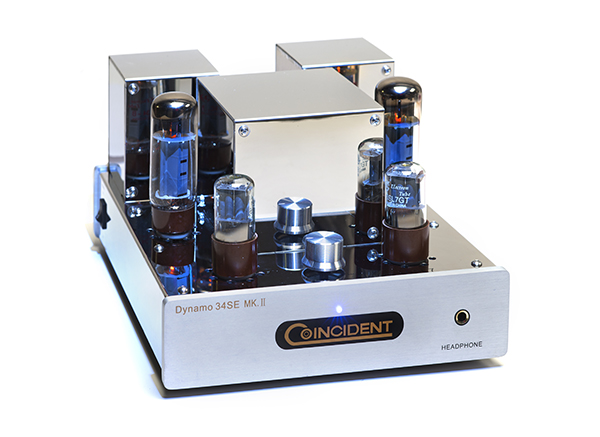
There is a coherence to the single ended triode design that is tough to ignore. Passing the signal through a single triode in the output stage has a grain free purity that will have you converted in no time at all.
Critics around the world raved about the original version of this amplifier (Priced at $1,295) and though I haven't had any personal time with the original, every other Coincident product I've auditioned or owned has been a top of class product. The current Mk. II version is now $1,495, and has had nearly every component beefed up. Bigger transformers, bigger capacitors, more power supply capacity, etc., etc.
And the chassis is beautiful. As Coincident's owner Israel Blume comments, "While far more costly than chromed steel, stainless steel is non-magnetic, eliminating hysteresis distortion and the mirror finish is permanent = unlike chrome, which is prone to pitting and eventual peeling." This is not only a component you want to put front and center ? proudly, it?s a component you will probably hand down to a family member.
Heading straight for the female vocal tracks, Anja Garbarek's Smiling and Waving proves a revelation, with Ms. Garbarek's voice materializing between the two Coincident Dynamite speakers that have been sent along to review. My other favorites, Ella Fitzgerald, Shelby Lynne and Anne Bisson all seem to just walk out from inside the speakers in such an effortless, grain free, natural way. Even though they have a sensitivity rating of 90db/1-watt, the Mk. II drives them with authority.
It feels more like a 20 or 30 wpc amplifier, and my old Dynaco Stereo 70 (30wpc on a good day) runs out of steam quicker than this 8-watt per channel wonder. It?s amazing what solid vacuum designs coupled with modern manufacturing can produce.

Source:
www.audiophile-magazine.com
Coincident Speaker Technology
Statement Cables
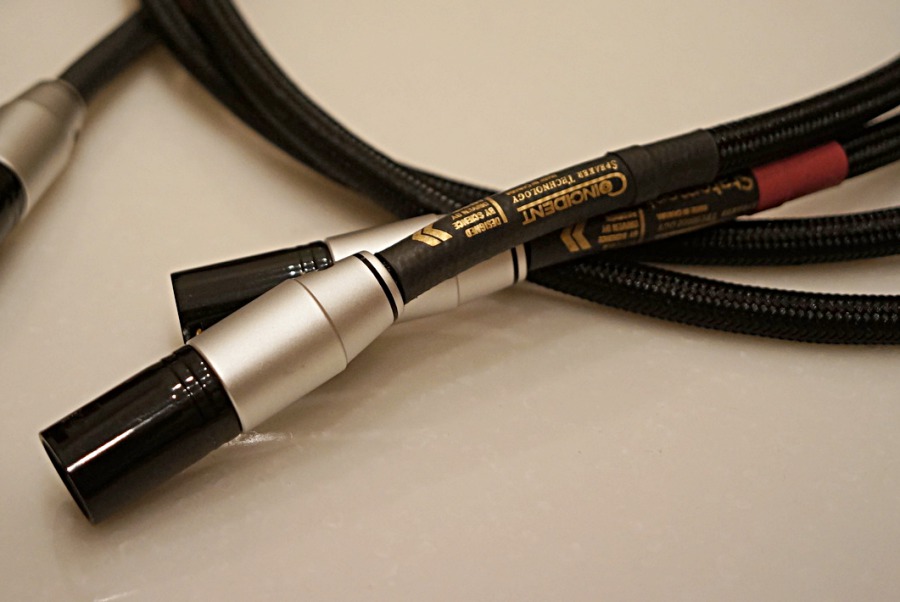
Coincident Speaker Technology est reconnu pour son rapport qualité prix assez inhabituel. Certes, la vente en direct explique sans doute une partie de la compétitivité de la production de Monsieur Israel Blume, mais les produits Coïncident Speaker Technology (CST) sont loin d'être fabriqués au rabais ou à l'économie, et sont, au contraire, conçus en utilisant des composants de qualités, dans un souci premier d'offrir le maximum de transparence et de naturel possible. Vous conviendrez que c'est plutôt un bon point de départ lorsqu'on vise la très haute fidélité...
L'entreprise canadienne a également le mérite d'avoir une production assez diversifiée entre enceintes et électroniques à tubes. Israel Blume propose ainsi un catalogue de produits qui s'étoffe petit à petit, avec des références qui s'inscrivent par ailleurs dans la durée.
C'est le cas de mon préamplificateur personnel (Coincident Statement Line Stage) qui reste chez moi un maillon central depuis de nombreuses années, sans que bon nombre de préamplificateurs passés entre mes mains aient réussi à le remettre en cause, et ce en dépit d'un prix relativement modeste dans le segment du high-end.
Israel Blume étant un constructeur très polyvalent, à l'instar d'un Touraj Moghaddam (CEO de Vertere et ex patron de Roksan), il restait à tester ses câbles, et pour éviter de tergiverser ou de supputer sur le potentiel de sa production, je me suis directement concentré sur sa nouvelle référence très haut de gamme : la série Statement !
2017 TAS Editors' Choice Awards
|
Dynamo MK II
|
Editors Choice
The Absolute Sound |
 |
|
M300B Frankenstein MK II
|
Editors Choice
The Absolute Sound |
|
World Premiere Review!
Classy styling and sophisticated sound for
passionate music lovers.
Review By Rick Becker
Coincident Speaker Technology
Dynamite Floorstanding Speaker
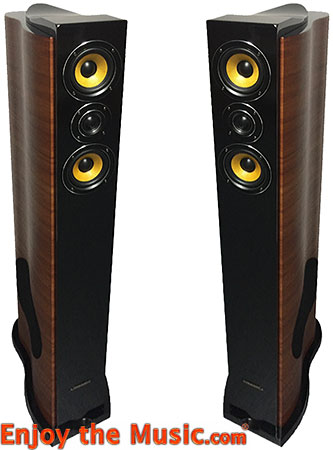
It's no secret that interior design has been trending modern for quite some time now. The trend was originally labeled "transitional", a blend between contemporary and traditional that remains popular with Boomers and Gen X. But "modern", in the flashback of "Mid-Century Modern" has caught the fancy of anyone younger than that. In furniture, there is a strong minimalist theme to Mid-Century Modern, but in a lot of other categories (think: cars and cutting edge hair styles) there is a lot of swoopiness happening, and in clothing and personal accessories (think: watches and jewelry) there is a lot of bling being bought. I suspect a lot of this is due to the homogenization of global cultures brought on by the smart phone with its built-in camera and internet access. Almost everything can be seen by almost everybody. And a lot of those "everybodies" aspire to what the wealthy have, as unbridled capitalism threatens to enslave even the most powerful of national governments.
World Premiere!
A gateway product to high-end tube gear.
Review By Rick Becker
Coincident Speaker Technology
Dynamo 34SE MK II
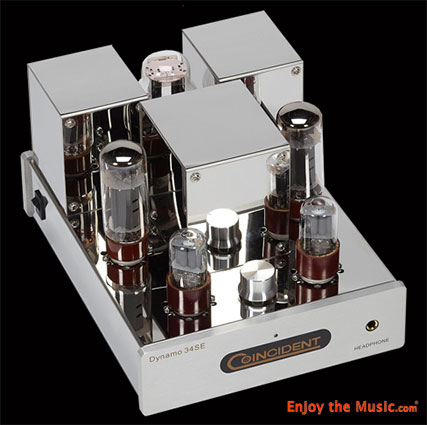
Oh geez, not another Coincident review by Rick Becker? Well, yes, and for good reason in this instance. The original Dynamo 34SE was my go-to amp for the $5000 Entry Level Project back in August of 2014 and I eagerly snapped up the review sample for my personal low power reference and headphone amplifier. My review today of the Coincident Speaker Technology Dynamo 34SE MK II is to find out what improvements have been made. Getting back to the original, it was an outstanding performer with efficient speakers and a very high value at $1299. Here was an opportunity for a direct comparison review between that amp and the new Coincident Speaker Technology Dynamo 34SE MK II.
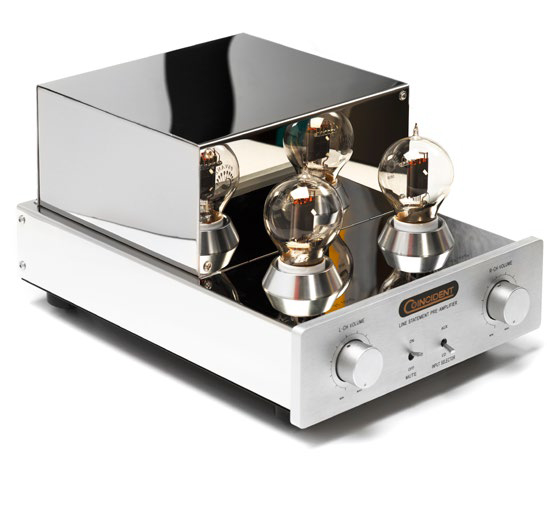
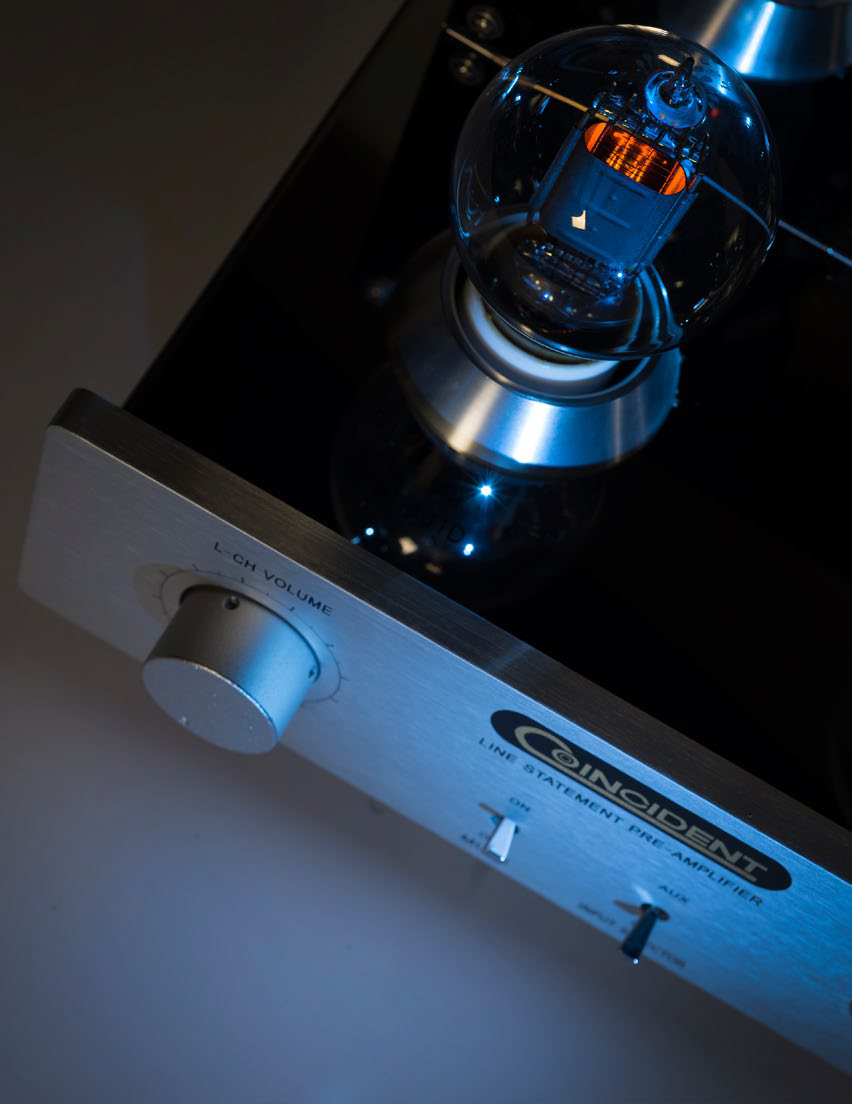
The Coincident Statement linestage delivers performance so far beyond what you'd ever expect from a $5,495 box, all audiophile clichés are rendered irrelevant. Tightly focused in nature, the Statement delivers high performance and is beautifully packaged in polished stainless steel.
With two inputs and two outputs each (switchable between RCA and XLR), control flexibility is limited. But seriously, how many of you have more than a DAC/ streamer and a phonostage anyway? If you can get by with this and forgo the flexibility of a remote control, the Statement delivers sheer performance that a lot of $20,000 preamplifiers don't.
This two-tube marvel, with a massive 42 pound external power supply, renders a musical picture that is dynamic, tonally gorgeous and quiet. With replacement 101- D tubes only costing $200/pair (a pair of premium, matched 101-Ds more, at $700/pair) and a claimed life of 5,000 - 10,000 hours, this one won't break you when it's time to retube.
The Statement is as good as it gets and after 12 years of reviews, we'd put it right at the top of what is possible in preamplifiers at any price. That you can get one straight from Coincident for $5,495 is the high end audio bargain of a lifetime.
The Coincident Statement Linestage
Nothing but Performance
By Jeff Dorgay
TONEAudio Magazine - Awards Issue. No.80 2016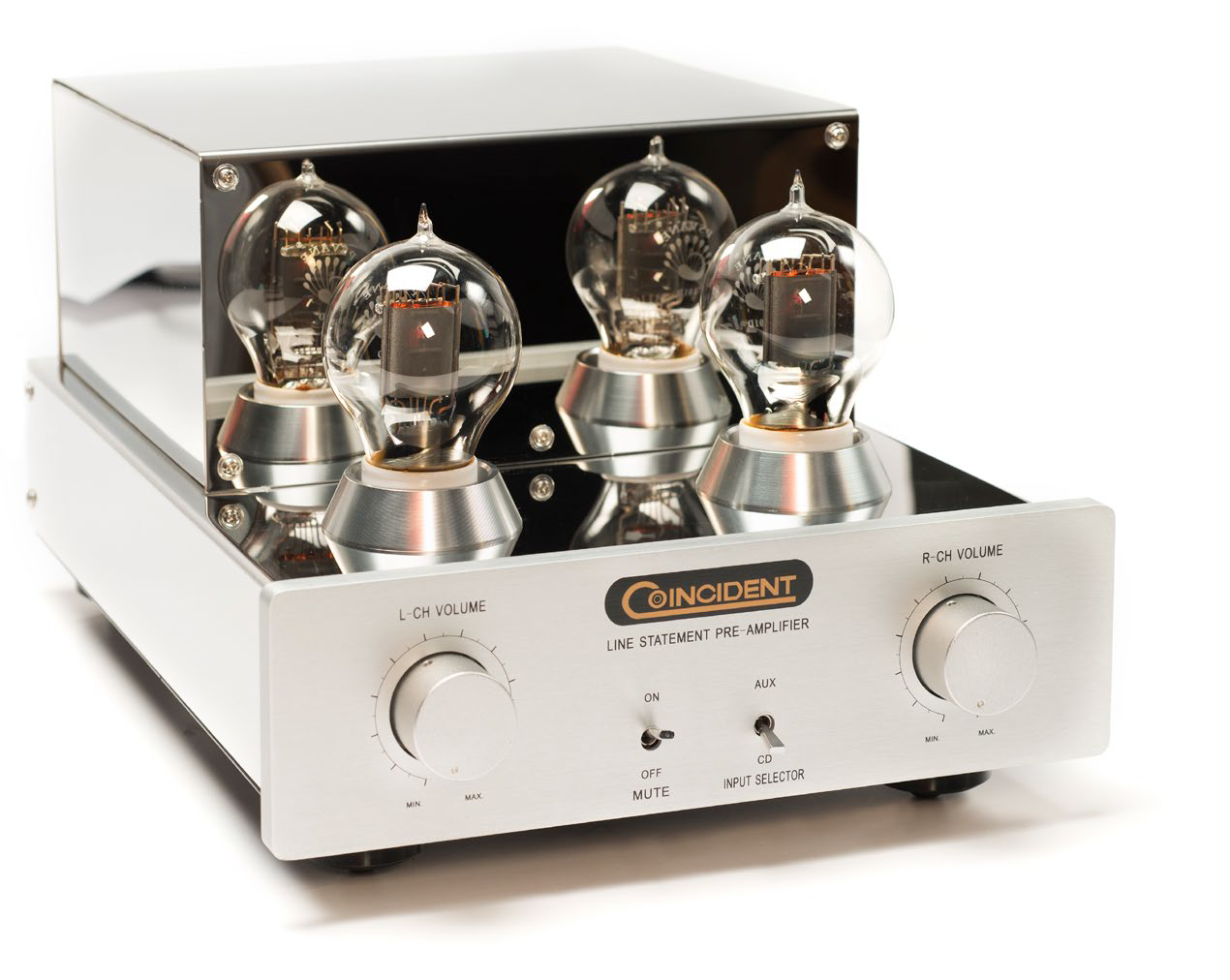
As the grungy lead guitar riff of the Drive-By Truckers' latest album American Band fills the room, it's clear that the Coincident Statement Linestage is a cut above. Way above what you'd expect from a $5,499 line stage. In some circles, you can't even buy a power cord for five grand, let alone a line stage that holds its own with some of the world's finest by the known brands. Gorgeously shiny, this two chassis masterpiece from Canada is just as stunning as the Statement Phonostage we reviewed a few years ago. Coincident's founder, Israel Blume, makes it a point to tell me that the chassis is not chrome plated, but high grade stainless steel, highly polished, which has multiple benefits. "The polished stainless is much more labor intensive, and unlike chrome plating, will never pit or peel. And, the non-magnetic nature of stainless steel provides a significant sonic benefit by eliminating any electromagnetic interaction with the transformers and audio circuitry." After many hours of listening, it only gets better.
Coincident Speaker Technology
Dynamo 34SE
The Absolute Sound - Buyers Guide 2017 - Issue 267
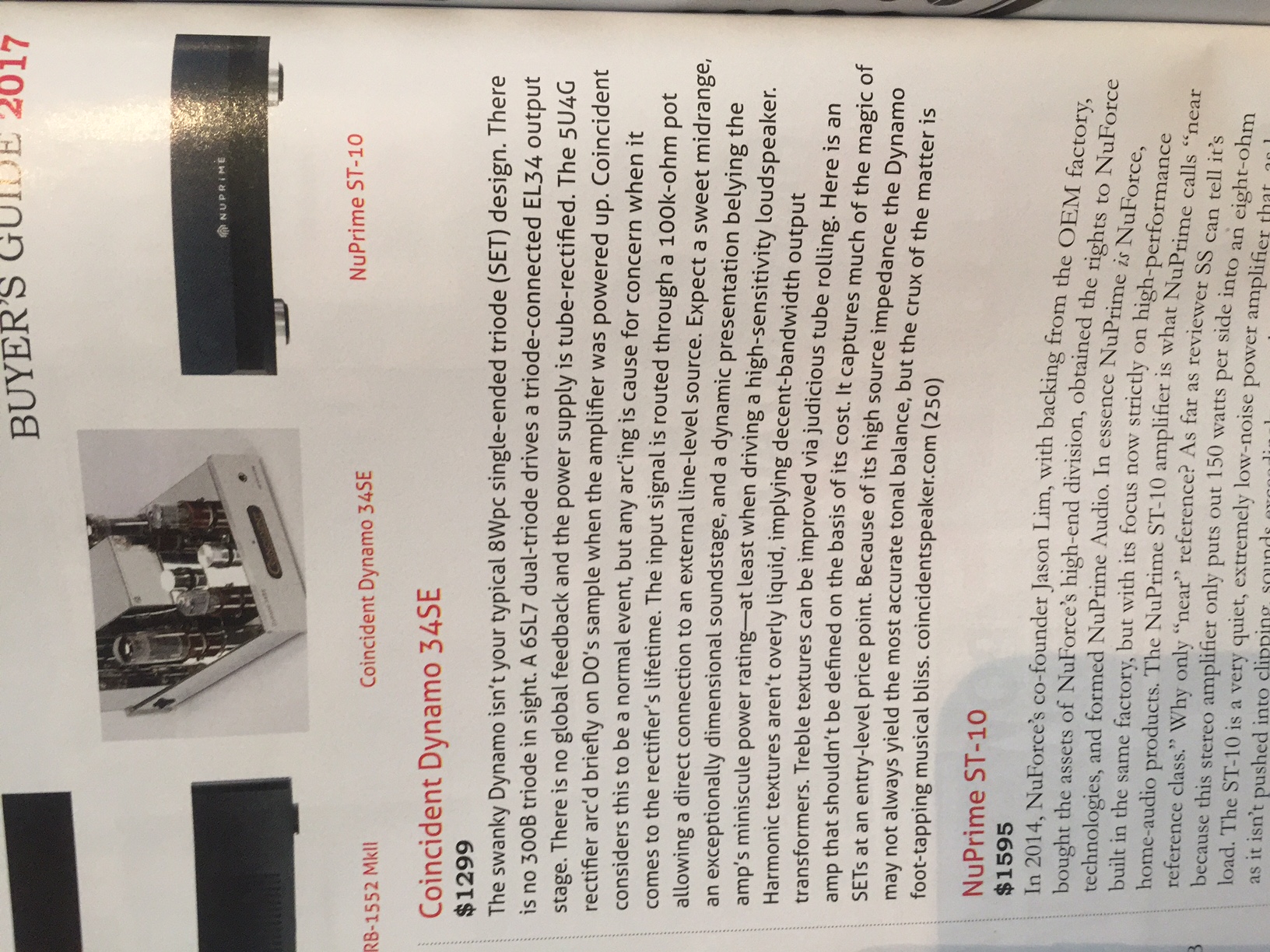 The swanky Dynamo isn't your
typical 8Wpc single-ended triode (SET) design. There is no 300B
triode in sight. A 6SL7 dual-triode drives a triode-connected
EL34 output stage. There is no global feedback and the power
supply is tube-rectified. The 5U4G rectifier arc'd briefly on
DO's sample when the amplifier was powered up. Coincident considers
this to be a normal event, but any arc'ing is cause for concern
when it comes to the rectifier's lifetime. The input signal is
routed through a 100k-ohm pot allowing a direct connection to an
external line-level-source. Expect a sweet midrange, an
exceptionally dimensional soundstage, and a dynamic presentation
belying the amp's miniscule power rating-at least when driving a
high-sensitivity loudspeaker. Harmony textures aren't overly
liquid, implying decent-bandwidth output transformers. Treble
textures can be improved via judicious tube rolling. Here is an
amp that shouldn't be defined on the basis of it's cost. It
captures much of the magic of SETs at an entry-level price
point. Because of its high source impedance the Dynamo may not
always yield the most accurate tonal balance, but the crux of
the matter is foot-tapping musical bliss. coincidentspeaker.com
(250)
The swanky Dynamo isn't your
typical 8Wpc single-ended triode (SET) design. There is no 300B
triode in sight. A 6SL7 dual-triode drives a triode-connected
EL34 output stage. There is no global feedback and the power
supply is tube-rectified. The 5U4G rectifier arc'd briefly on
DO's sample when the amplifier was powered up. Coincident considers
this to be a normal event, but any arc'ing is cause for concern
when it comes to the rectifier's lifetime. The input signal is
routed through a 100k-ohm pot allowing a direct connection to an
external line-level-source. Expect a sweet midrange, an
exceptionally dimensional soundstage, and a dynamic presentation
belying the amp's miniscule power rating-at least when driving a
high-sensitivity loudspeaker. Harmony textures aren't overly
liquid, implying decent-bandwidth output transformers. Treble
textures can be improved via judicious tube rolling. Here is an
amp that shouldn't be defined on the basis of it's cost. It
captures much of the magic of SETs at an entry-level price
point. Because of its high source impedance the Dynamo may not
always yield the most accurate tonal balance, but the crux of
the matter is foot-tapping musical bliss. coincidentspeaker.com
(250)
Préamplis à tubes haut de gamme
NAGRA Jazz
Vs
COINCIDENT TECHNOLOGY Statement Line Stage
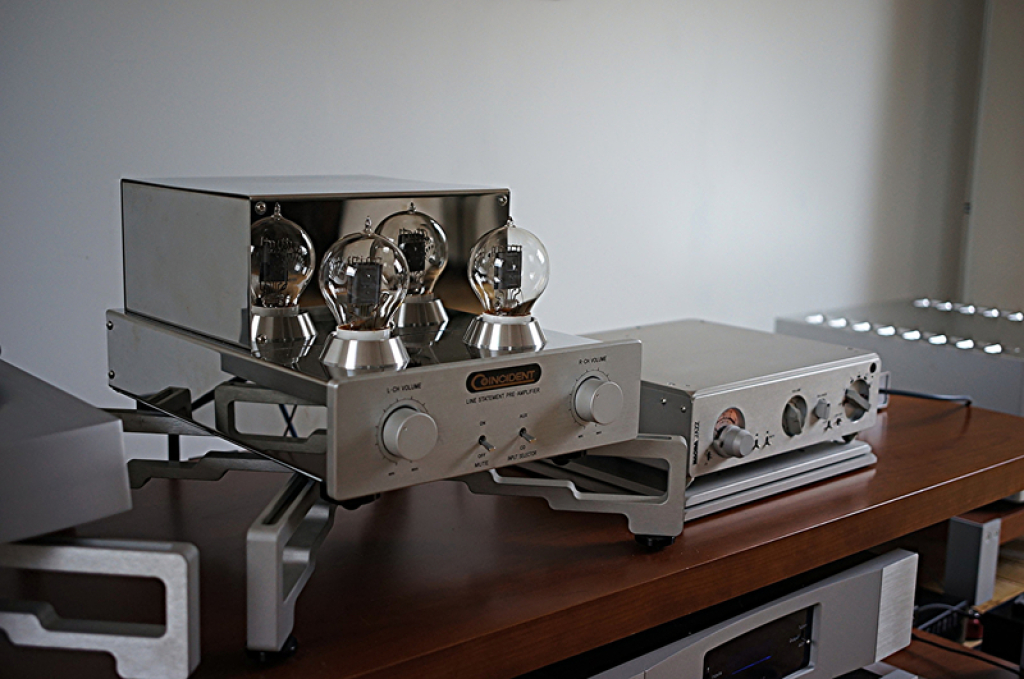
|
C'est un premier face à face inédit entre un représentant de l'industrie électronique de précision Suisse et un autre de la grande tradition nord-américaine des préamplis à tubes.
Ces deux-là sont des propositions assez uniques dans leur genre, avec d'une part un nouveau Nagra tentant d'imposer un schéma sans fioritures avec des liaisons courtes et directes, et d'autre part un préampli canadien mettant en œuvre des triodes à chauffage directe vintage sur des liaisons encore plus courtes et minimalistes. C'est presque un test match sur la transparence, qualité essentielle pour un préamplificateur de haute volée. Et ce qui est sûr, c'est que nous avons affaire là à deux appareils de très haut niveau.
Le but de cette confrontation n'est pas forcément de désigner un vainqueur parmi ces deux appareils d'exception mais de présenter des caractéristiques qui pourront, en fonction des besoins et du système de chacun, faire pencher la balance d'un côté ou de l'autre...
Dynamite
Coincident is very excited to announce the introduction of the Dynamite loudspeaker. This represents the initial foray for Coincident into the realm of floor standing, full range, high end speakers at a decidedly mid fi price. In keeping with the philosophy that began with the release of the Dynamo 34SE amplifier, the Dynamite loudspeaker offers build quality, design, aesthetics and performance that was previously not possible at this price point. The combination of the Dynamite and the Dynamo yields high end sound at an unbelievably affordable price.
The Dynamite is capable of reproducing all types of music, in a manner that will satisfy the demands of the most seasoned listener. Its compact footprint makes it an ideal speaker for those with limited space and yet it is fully adept at filling a spacious listening environment. Due to its high sensitivity and wide power handling capabilities, amplifier choice is a personal one. Single ended triode tube amps fully realize their inherent sonic advantage mated to the Dynamite and those with a preference for higher power tube or solid state amps will be equally enamoured by the results.
The same design approach and philosophy of enclosure materials, crossovers and driver choice apply to the Dynamite as it does to the vastly more expensive Coincident models. The breakthrough price to performance ratio has become possible due to high volume and efficient production, off shore cabinet construction, direct to consumer pricing and the lowest mark up structure in high end audio.
2016 TAS Editors' Choice Awards
|
Dynamo 34SE
|
Editors Choice
The Absolute Sound |
 |
The Dynamo offers an alternative to the traditional 300B-based single-ended-triode amplifier, using, as it does, a triod-connected EL34 pentode.Driving a high-sensitivity, high-impedance loudspeaker (96dB/8-ohm minimum), it is capable of an explosive first watt. Superlative soundstage transparency combined with 3-D image outlines produce a strong sensation of being there.
|
M300B Frankenstein MK II
|
Editors Choice
The Absolute Sound |
|
One of the best-sounding 300B SET apms DO has auditioned, Israel Blume's Frankenstein IIs deliver on the promise of SETs: a midrange to die for, wonderful tonal color saturation, and spectacular imaging. In short, a sensational first watt! Its combination of affordability and performance makes for a screaming buy reccomendation with the right speakers.
Dynamo 34SE MK II Amplifier
After the overwhelming success of the Coincident Dynamo 34SE amplifier ( Editor’s Choice TAS, Blue Note Award by enjoythemusic.com ) we are excited to announce the Dynamo SE 34 MK II. The MK II contains a whole host of significant upgrades that not only enhance performance but dramatically improves reliability, virtually eliminates noise, hum and susceptibility to AC line variation and fluctuation. The end result is taking the already breakthrough performance and build quality of the finest value amplifier in existence and elevating it to a new level of excellence in every parameter. The improvements include the following:
1. Power Supply - The power transformer has been enlarged by 50%. Much improved
insulation and winding techniques result in noiseless operation, and a 40% reduction in generated heat
levels.
Filtering and energy storage has been increased by a whopping 70%. The sonic improvement is substantial-
deeper, more impactful lower frequencies, wider dynamics and the ability to drive a much wider range of
speakers without strain. Distortion levels at high SPLs and low frequencies has been reduced by 35%.
Furthermore, the large power supply has now been isolated from the sensitive input circuitry resulting
in the elimination of electromagnetic interference.
2. Chassis - Not only is the chassis 20% larger in order to accommodate the huge new power transformer, it has been stiffened and braced to reduce unwanted resonances. Sonically this translates to greater purity and transparency. The Dynamo has gone from weighing 22 lbs to 30 lbs.
3. Capacitors- Every single capacitor has been doubled in voltage capacity which provides bullet proof reliability and eliminates potential problems in areas afflicted with high AC line voltage that is prone to surging and/ or fluctuation.
4. Tube Rectifier - The previously used instant on 5U4GB rectifier tube has been replaced with the soft start 5AR4. This provides a safeguard against excessive inrush current upon turn on.
The overall improvement wrought by the MK. II is highly significant. From virtually eliminating noise so that the Dynamo can successfully be used with ultra high sensitivity speakers and increasing its power capabilities so that it can mate with a wider range of lower sensitivity speakers to unshakeable reliability in any environment to stunning performance enhancements that include deeper, punchier bass, greater transparency and purity overall, more expansive soundstage and greater extension and air in the treble all combine to create an amplifier that while is hard to surpass at $5000, is unmatched at its value laden price of only $1499 US. While the original Dynamo 34SE at $1299 US was considered the finest value in all of high end audio, all the huge and costly improvements incorporated in the MK. II with only a $200 increase in price, make the MK. II even more of an audiophile bargain.

6moons.com Audio Reviews
Reviewer: Tim Smith
Financial interests: click here
Source (digital): 2 TB iMac 27” quad-core with 16GB RAM, AIFF, iTunes, streamed
to Apple Airport Express; Musical Paradise D-1; MHDT Labs Paradisea+; Maverick Audio Tube Magic D1;
Marantz SA-8003 and SA-15S2 Limited Edition SACD players; Marantz CD5003 and 5004 as transport;
Resonessence Labs Herus
Source (analog): Pro-Ject RPM 10.1 with Dynavector 10x5
Phono preamplifier: Graham Slee Era Gold Mk V
Preamplifier: Audio Research LS17
Amplifiers: FirstWatt F5; Line Magnetic 518IA; Wyred4Sound SX-1000 monos; Musical
Paradise MP 301MkII and mk3 Deluxe; Coincident Dynamo SE; Bottlehead Crack DIY amplifier, Musical
Paradise MP-303
Loudspeakers: Harbeth Compact 7-ES3; Tekton Design M-Lore; Magnepan 1.7; Mordaunt Short
Carnival 2; DIY with Fostex FE 103; Pioneer SP-BS41-LR
Headphones: Beyerdynamic DT 770 (32 Ohm) and DT 880 (600 Ohm); HiFiMan HE-400 with
Audio Sensibility Impact SE 7N OCC cables
Cables: Audio Sensibility Impact SE; DH-Labs Q-10; Connex/DH Labs BL-Ag; Kimber Kable
4TC, PBJ; Paul Speltz Anti-Cables; Canare; Cardas; QED; Connex/DH Labs power cords; Shunyata Research
Venom HC
Power conditioning: Shunyata Research Venom PS8 with Venom Defender; Emotiva CMX-2
Equipment rack: Apollo, Target, Tableau
Isolation devices: Cardas blocks; Teo Audio-supplied 'earthquake foam'
Speaker stands: Skylan
Room size: 8.5 meters long with nook at each end; 3.3 meters wide; 2.1 meters high
Review component retail in USA: $1'499
'Anything you can do I can do better; I can do anything better than you' wrote Irving Berlin for the 1946 Broadway show Annie Get Your Gun. This is the implicit message of audio designers who launch a 'mark 2' version less than two years after the initial offering, sometimes to the chagrin of the purchasers of the original. When Israel Blume emailed 6moons to ask if I would be interested to follow up my September 2014 review of his $1'299 Coincident Dynamo 34SE with a comparison to the new $1499 Dynamo MkII, I was surprised. I'd thought the original was a fabulous amplifier punching well above its weight in just about every category. If it ain't broke, don't fix it. Having engaged in an obsessive buying binge of ChiFi push-pull and SEP amps from 2010-2014, I thought that the Dynamo was possibly without peer at its price. Accordingly, I'd bought the amp which since 2014 has acted as the solid anchor of my second system adding weight, warmth and drive to every small bookshelf speaker I paired it with. If the Dynamo had more than one input and remote control, I'd be tempted to sell more expensive gear and use it as my main amplifier with high-efficiency speakers. What could the MkII offer which the original amplifier had not?
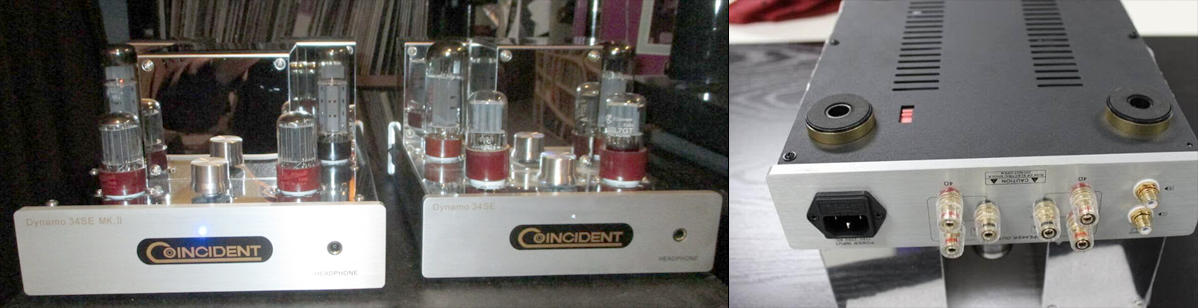
As it turns out, a great deal. Your additional $200 buy an extra 4.5 kilos or 10 pounds of transformer iron, bigger and better capacitors, a shorter signal path, better grounding and several other upgrades. This 15kg amp is to the single-ended pentode EL34 amp family what the 45kg Mastersound amps are to the single-ended triode 845 genre. With their over-spec'd transformers bulging from their cases, these products surprise with their ability to manhandle complex music.
With substantially larger irons, the Dynamo MkII is not simply more of the same. It's like going from the Prologue to the Dialogue series in the Primaluna product range. They are worlds apart. Capacitance goes up 50% for more headroom and deeper bass - not just drier and deeper bass but noticeably more dimensional and on certain recordings, it must be said, a touch of bloat. Sonically this is the only weakness but entirely expected of a SEP amp. Ten extra pounds of iron won't overcome the typology's limitations. But with each passing year it seems that the gap between tube and transistor amps narrows and the MkII is clear proof. With voltage capacity increased by 40% and a shorter signal path, there should be more incisiveness and certainly is. Guitars pierce the air just a little bit more. The MkII seems a bit faster, better able to keep up with techno beats, better able to track dynamic swings with orchestral music and heavily produced rock. I was thoroughly satisfied with the way the Dynamo MkII handled "Dark Side of the Moon". it was noticeably more propulsive than the MkI and rendered the clock bells on "Time" with a touch more depth and body. Micro detail emerged from a quieter background. This amp strove for a different sonic signature.

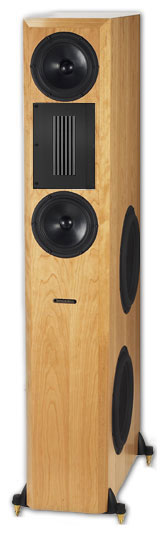 Enjoy the Music.com's Special 20/20
Award
Enjoy the Music.com's Special 20/20
Award
High-End Audio Loudspeakers
Steven R. Rochlin chooses the most notable products during the past 20 years.
As Chosen By Editor & Creative Director Steven R. Rochlin
Coincident Speaker
Technology Total Victory IV
Longstanding Canadian manufacturer Coincident Speaker Technology produces critically-acclaimed amplifiers and loudspeakers. Rick Becker reviewed their Super Victory loudspeaker and felt that following up with their upper line Total Victory IV ($14,999 per pair) would be a simple task. What he was not prepared for was... "The step from the Super Victory to the Total Victory will be necessary if your room is about 6000 cubic feet or larger" says Rick. "I expect when putting a TV IV in a smaller room the extra $5500 will buy you mostly the qualitative improvements (versus the smaller model)... It is not that the three models sound dramatically different from one another in tonal balance. But as you move up the line the audible quality improves and they can play in larger rooms. The common denominators: slightly warm, non-fatiguing, very revealing, transparent, dynamic, totally enjoyable." You can read Rick Becker's review of the Coincident Speaker Technology Total Victory IV speaker here.
Enjoy the Music.com's Special 20/20 Award
High-End Audio Preamplification
Steven R. Rochlin chooses the most notable products during the past 20 years.
As Chosen By Editor & Creative Director Steven R. Rochlin
Coincident Statement Line Stage
 While any award list has the obvious components you've read about time and
again, yet what about those secret sleepers? Lovers of vacuum tubes might not have used the truly
beautiful 101D. Not sure why as it proves its merits within the Coincident Statement Line Stage ($5000).
The two large 101D tubes are about the size and shape of a standard incandescent light bulb and give off
a gentle glow. This two-chassis design includes a 40 pound separate power supply to mate with the 30
pound linestage. There are two unbalanced RCA inputs and balanced XLR, with outputs being both RCA and
XLR. We're not quite sure how Coincident gives you so much for $500, yet we're surely not complaining
either. "When I first heard the Statement Line Stage I knew it was a very special piece," says
reviewer Rick Becker, "But it took some playing and tweaking to learn how good it really is. You
can't build a world class system with a plug 'n' play mentality. As a replacement for a full function
preamp it will force you to re-think your front end, yet it also offers flexibility for bi-amplifying as
well as a balanced source and balanced amplifier. The seldom seen (but not outrageously priced) 101D
tube is the crown jewel of this design and it will give you a high degree of exclusivity in audiophile
circles. Sonically, the Statement is a thoroughbred with Triple Crown potential, a serious assault on
the State of the Art at a price that should recalibrate "value" in the high-end. It may very
well be the finest piece ever to have come from the mind of Israel Blume. I expect it will remain my
reference for many years to come." Read Rick Becker's
review of the Coincident Statement Line Stage here.
While any award list has the obvious components you've read about time and
again, yet what about those secret sleepers? Lovers of vacuum tubes might not have used the truly
beautiful 101D. Not sure why as it proves its merits within the Coincident Statement Line Stage ($5000).
The two large 101D tubes are about the size and shape of a standard incandescent light bulb and give off
a gentle glow. This two-chassis design includes a 40 pound separate power supply to mate with the 30
pound linestage. There are two unbalanced RCA inputs and balanced XLR, with outputs being both RCA and
XLR. We're not quite sure how Coincident gives you so much for $500, yet we're surely not complaining
either. "When I first heard the Statement Line Stage I knew it was a very special piece," says
reviewer Rick Becker, "But it took some playing and tweaking to learn how good it really is. You
can't build a world class system with a plug 'n' play mentality. As a replacement for a full function
preamp it will force you to re-think your front end, yet it also offers flexibility for bi-amplifying as
well as a balanced source and balanced amplifier. The seldom seen (but not outrageously priced) 101D
tube is the crown jewel of this design and it will give you a high degree of exclusivity in audiophile
circles. Sonically, the Statement is a thoroughbred with Triple Crown potential, a serious assault on
the State of the Art at a price that should recalibrate "value" in the high-end. It may very
well be the finest piece ever to have come from the mind of Israel Blume. I expect it will remain my
reference for many years to come." Read Rick Becker's
review of the Coincident Statement Line Stage here.
2015 TAS Editors' Choice Awards
|
Dynamo 34SE
|
Editors Choice
The Absolute Sound |
 |
Dynamo 34 SE -The Dynamo offers an alternative to the traditional 300B based single - ended - triode amplifier, using , as it does, a triode - connected EL 34 pentode. Driving a high - sensitivity , high impedance loudspeaker, it is capable of an explosive first watt. Superlative soundstage transparency combined with 3-D image outlines produce a strong sensation of being there. DO, 250.
|
M300B Frankenstein MK II
|
Editors Choice
The Absolute Sound |
|
Frankenstein M300B MK. II - One of the best - sounding 300B SET amps, DO has auditioned. Israel Blume's Frankenstein IIs deliver on the promise of SETs: a midrange to die for, wonderful tonal color saturation, and spectacular imaging. In short, a sensational first watt! Its combination of affordability and performance makes for a screaming buy recommendation with the right speakers. DO, 228.
2014 TAS Editors' Choice Awards
|
Partial Eclipse II
|
Editors Choice
The Absolute Sound |
 |
|
Pure Reference
Extreme |
Editors Choice
The Absolute Sound |
|
|
Frankenstein II
|
Editors Choice
The Absolute Sound |
|
|
Super Victory
|
Editors Choice
The Absolute Sound |
|

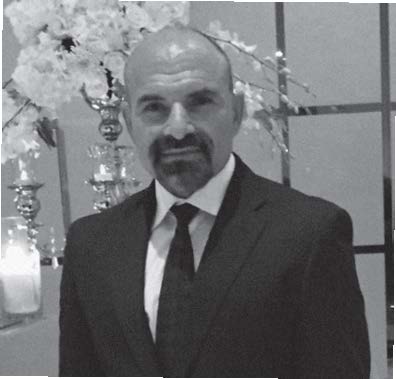
The Absolute Sound - Issue 256
Back Page
Israel Blume, President,
Coincident Speaker Technology
Neil Gader
What ignited your passion for the high end? Did it come from the music side or the electronics side?
My passion was ignited when, during my first year at university in 1972, I started working at an audio store. I came across an amp and a preamp and had no clue why two components were necessary when a receiver performed the same task. I listened to the separates playing Bad Company, an LP I had heard numerous times. But never like this. That was it. My passion for audio was transformed to a virtual obsession. That experience changed my life forever. It has always been about the music. The hardware became its harbinger to deliver the musical message more convincingly and at a much higher level. I quickly became fascinated by the components and knew my future would be inextricably interconnected to the creation of components that would be responsible for enhancing the musical experience
What was your first high-end system? What year was this?
1973. Luxman M75 power amp, Luxman CL 35 preamp, Acoustique 3A Master Control speakers, Micro Seiki turntable.
When did audio develop from a hobby to a career?
From 1972–76, I continued to work part-time and summers at that audio store, gradually being responsible for transforming it from a purveyor of mid-fi gear to high end. We started selling Acoustat X speakers, Luxman separates, etc. Afterwards I began importing high-end gear into Canada and began to build and modify components on a special order basis. I started Coincident Speaker Technology in 1993 for the sole purpose of creating the finest loudspeakers in the world, which eventually blossomed into the creation of the entire audio chain except for a source component.
What education did you receive?
Undergraduate and Master’s degrees in science and a Doctor of Laws degree. How do you find the time to design electronics, loudspeakers, and cables? Music and the creation of audio components are my obsession. It literally is a sevendays- per-week preoccupation fueled by the insatiable desire to create the most musically satisfying audio system possible. Being meticulously organized and efficient has proved to be invaluable.
How do you define the difference between hi-fi and high-end audio?
My definition of a high-end audio system is one that has the capability of making the listener forget the hardware and become totally and completely immersed in the musical experience. Hi-fi involves those who use music to listen to and evaluate their systems. The music must always be the end, not the means to the end.
Analog or digital—what is your preference and why? Do you still enjoy LPs?
No doubt, it is analog. Digital has come a long way and has reached the point where the enjoyment of music is achievable. I listen to the best digital and my reaction is positive until I put a great LP on my reference turntable. Digital as well as solid-state electronics share the same deficiency when it comes to replicating the live musical event in a home. Namely, the inability to render harmonics accurately and to capture low-level detail. Both media do very well in transmitting musical fundamentals but when the proportion of fundamentals to harmonics is skewed, the end result is music reproduction that never sounds real. The finest analog and tube technologies both possess this quality. Even non-audiophiles can clearly hear the greater sense of realism presented by the LP.
Are you surprised at the resiliency of high-end two-channel?
It does not surprise me, since for those who love music, a two-channel audio system will simply pull one into the magic that is music.
How will high-end systems change in the next ten years or so?
Analog and high-performance two-channel music systems will continue to exist albeit in declining numbers. The future will see the overwhelming majority either not have any form of audio system at all or gravitate to more convenient, very simple forms of audio reproduction.
What are the greatest challenges confronting the high end?
The new generations are weaned on multitasking and sensory overload. High-end audio depends on those who derive tremendous satisfaction and joy through focusing on listening to music devoid of distraction. The new generation does not appear to embrace this most rewarding of human experiences.
Outside of audio, what do you do for fun?
I am a car nut and love driving high-performance sport cars and caring for them. Working out every day is also a life’s mission from which I do not deviate.
What still inspires you about your work?
The love of music and creating components that enhance the musical experience not only for me but also for all other music lovers. Nothing gratifies me more than a Coincident buyer who tells me that my gear has enhanced his life.

Click on the image to view print version.
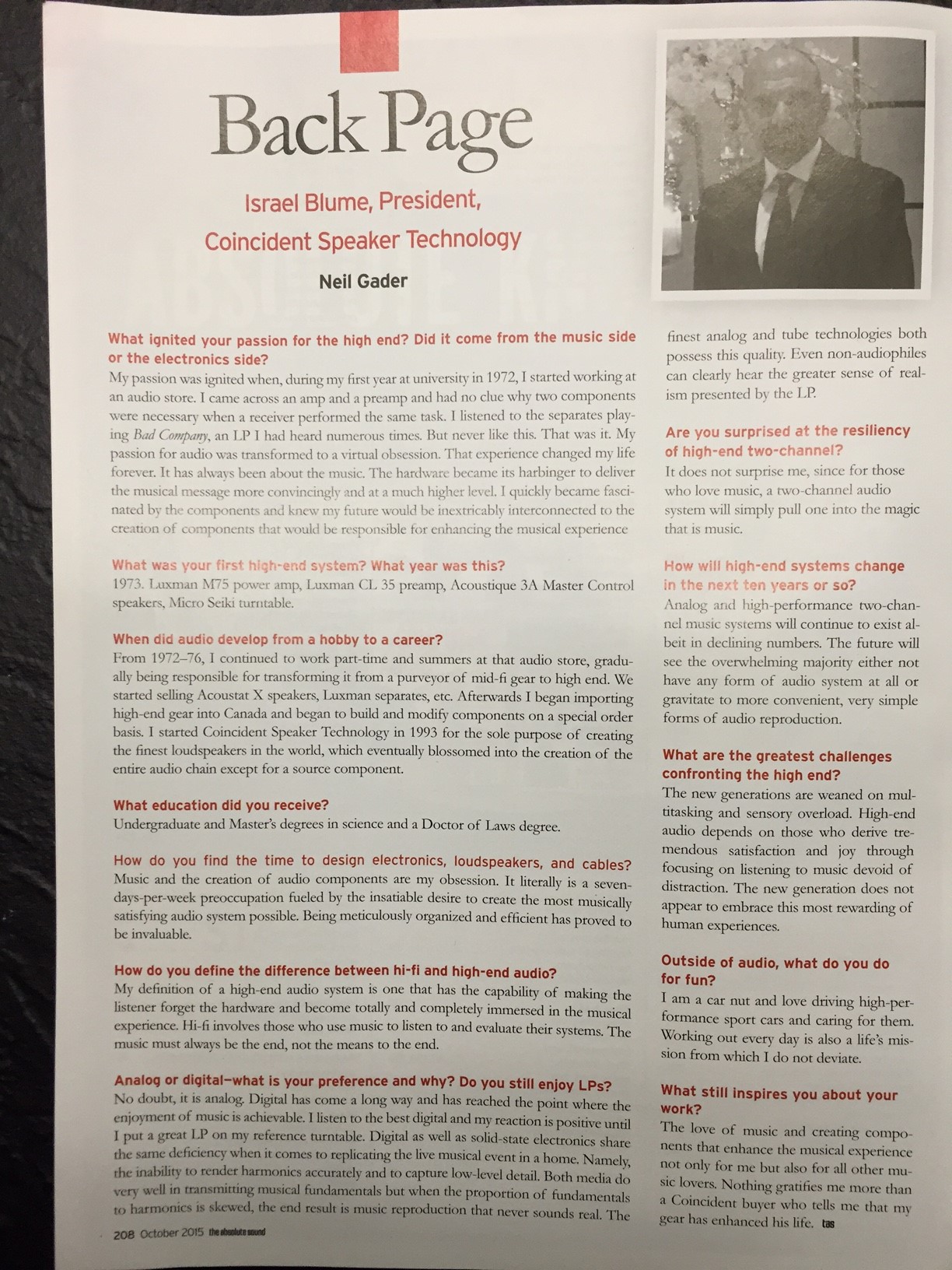
Coincident Speaker Technology
Statement Series Cable
White Paper
CST Advanced Technology- The Latest Breakthrough
To celebrate Coincident Speaker Technology 20th Anniversary, we are thrilled to announce the Statement Series A breakthrough in cable technology and performance. The Statement Series' superiority is not predicated on a single novel technique or approach but rather that the design for the Statement Series (and the CST Extreme) is based upon genuinely advanced technology, applied in a "total system" approach, to each specific cable application, always in accordance with CST's basic controlling philosophy that the cable should pass the signal exactly as it receives it, with no addition, subtraction, or perversion.
One example of CST's advanced technology is found in its proprietary "WaveLink" winding geometry. Although many other cable manufacturers recognize the effects of ambient electromagnetic fields, and some (but many do not) are cognizant of electromagnetic fields self-generated by internal current flow, Coincident is still one of the few cable manufacturers in the world to recognize and design for the fact that all cables in operation generate both electromagnetic and electrostatic fields within and surrounding them.
These internally generated fields (the intensity of the electromagnetic field controlled by current flow, and that of the electrostatic field controlled by voltage) both individually and by their interaction affect the signal passing through the cable, and therefore profoundly impact the sound of the entire system.
Signals passed in each cable application all have different relative amounts of current flow (amperage) and voltage1, but there is only one optimum relationship for the two fields that result from them. Therefore, every CST cable, in every series from Extreme all the way up to the STATEMENT Series, is specifically designed to produce that one optimum relationship in its own application. CST cables are wound uniquely and look different from each so that all will have the same optimum field relationship, whatever their application. This is CST's exclusive "WaveLink" technology, and it's one of many of the reasons CST cables sound closer to the original signal than its competitors.
The STATEMENT Series' incredible detail, focus and ambience retrieval lies in another example of CST's advanced technology: Functionally, cables (of any brand, even CST) have many of the characteristics of capacitors: They store energy in their dielectric (on a cable, that means the insulation) and they release it out of phase, directly into the signal path every time the carried signal changes polarity. This out-of-phase energy results in cancellation of the signal information at very low levels (like the fifth bounce of the music off the walls of the concert hall), and works to reduce detail, blur imaging, and even result in "phantom" signal artifacts ("noise" signals that aren't a part of the recording being played) to further compromise listening enjoyment. Coincident is one the few cable manufacturers to recognize and successfully address this important issue.
Cable Design and Construction What is Important? Everything !
Coincident's "total system" approach to cable design is exactly what the term implies: Every aspect of every parameter of each CST design is taken into consideration and optimized, before the design is finalized and put into production. This painstaking process takes years and literally thousands of hours of R & D and aural evaluation.
Many cable manufacturers believe that there can be one "magic" solution that will always result in "perfect" cables. This simplistic approach will yield a highly compromised product. While many view cables as bits of wire and plastic, cables are extremely complex in their operation, and each of its component parts greatly affects their performance: The geometry and material used for the conductors (usually either copper or silver in most audio cables) has a clear and obvious effect on the sound of your system. Equally relevant is the thickness (the AWG gauge) of the conductors, their purity, how they were made, and whether they are solid-core or stranded. Dielectric and capacitive discharge effects mean that the choice of insulating material for the primary wires, it's dielectric constant, its "dielectric absorption" or "dissipation factor", its "dump rate", and how thickly it's applied and its air to solid ratio are all crucial in accurately passing the signal the cable is fed. Furthermore, the type and thickness of each of the overall conductor jackets, the filler materials, if any, and the final overjacket on the finished cable all combine to greatly impact on the veracity of the resultant signal. Whether or not the cable is shielded is highly significant as well, because shielding even shielding done the way CST does it can affect sound quality and overall system performance. And so can the spacing of the shield, if any, over the cable and the spacing of the conductors within it: The distance between them determines the capacitance and inductance of any pair of conductors, and those factors, plus the resistance of the conductors themselves, are the sole determinants of the cable's characteristic impedance. The ultimate importance of absolutely everything in cable design is perhaps best illustrated by the circularity of its center core. If it is not perfectly round it will significantly affect how closely a coaxial cable will conform to its designed impedance specifications.
In designing its cables, Coincident takes every factor into consideration. Falter or neglect any design or construction parameter and the cable will be severely degraded. It is for these reasons that the STATEMENT Series is uniquely superior to virtually all other cables at any price, let alone at its unheard of selling price. Unlike other products that involve compromises that must be made to comply with budgetary considerations, the vagaries of the market, or the realities of manufacturing, the STATEMENT SERIES is designed and manufactured with none of the aforementioned restraints.
The STATEMENT Series is different. Absolutely uncompromised in any way, and representing the fullest development of the thoughts and skills of designer Israel Blume, the STATEMENT is, even as compared to CST's justly popular Extreme, a huge step forward. The goal of the STATEMENT SERIES is to produce a line of cables that pass the musical signal with as little coloration as possible and to replicate the accuracy of a direct bypass- in other words, to sound like no cable at all.
The STATEMENT Series Product Line
The STATEMENT Series consists of only six products:ST-1, The Single-Ended Interconnect, ST-2, The Balanced Interconnect, ST-4, The Digital Interconnect, (available either balanced or single-ended), ST-5, The Speaker Cable, (along with its companion product the ST-5/JS Jumper Set) andST-10, The Power Cable.
Materials and Construction
STATEMENT Series Interconnects
All CST STATEMENT Series interconnects and digital cables are made from custom-drawn and specially treated PC-OCC (Pure Copper, Ohno Continuous Cast copper, which is so pure that it actually exceeds the test capabilities of any commercial laboratory. The conductors of this extremely expensive material are individually insulated with thin films of a special PTFE-related fluoropolymer material and then arrayed in CST's own proprietary "WaveLink" geometry between an air- and nitrogen-bearing concentric two element fluoropolymer central core and a single element air-bearing fluoropolymer outer core. The insulation and core structure thus formed has a lower effective dielectric constant than any other kind or combination of commercially available materials. Where necessary for balanced or AES/EBU operation, a special grounding network is incorporated within the central core.
All connectors used on STATEMENT Series interconnects and digital cables are made to CST's own high standards. Every connector is non-magnetic, to avoid hysteresis effects, and each is designed for minimum self-inductance. Every part in the signal path of every STATEMENT Series connector is precision manufactured from either ultra-pure copper or from an ASTM-designated copper alloy selected to be best for its particular application. Where gold plating is used, it is applied directly, with no nickel substrate, just thickly enough to prevent connector tarnishing, without affecting sound quality. To ensure minimum self-inductance, steps are taken on every STATEMENT Series connector to remove all conductive materials not absolutely necessary to signal transmission from the signal path.
Speaker Cables
CST STATEMENT Series speaker cables are made from the same specially treated ultra-pure (exceeding U.S. commercial lab test capabilities) "PC-OCC" copper as is used for STATEMENT Series interconnects and digital cables. Multiple small-diameter conductors (23 AWG) of this material are individually insulated with thin films (0.076 mm or less) of a special PTFE-variant fluoropolymer material and implemented in accordance with Coincident"s special "WaveLink" geometry, over air-bearing composite multi-element concentric PTFE-variant core structures to make the cable's four individual conductor "legs". Each of these four legs is then wrapped and extruded with a twin-element PTFE-variant fluoropolymer jacket and the four legs are cabled, either around an air-bearing central core member or a special into a minimum-inductance "quad", and finally given a braided protective mesh outer jacket.
STATEMENT Series speaker cables are eight conductors of 16 gauge (AWG) in their normal "shotgun" configuration (2 legs per conductor) or four conductors of 12 AWG when terminated in the optional "bi-wire" mode. Protruding through these caps at either end are the actual hook-up ends of the cable. These are sheathed in multi-element air-dielectric tubes. The actual termination is, in every case, an individually billet-machined cryogenically-treated 24K direct gold-plated copper spade lug (of either 6.0 or 8.5 mm terminal size). Premium Deltron brand bananas are also available.
Specific Product Descriptions
ST-1 Single-Ended Interconnect - Much larger in diameter than would normally be expected from Coincident, this STATEMENT Series cable features unique jacketing braided from dense wear-resistant polyester. This results in truly remarkable dielectric characteristics and an understated, elegant "stealth-like" appearance and texture reminiscent of carbon fiber. Fully symmetrical windings and special geometry make this shielded single-ended cable unusually resistant to EMI and RFI.
Price: $595 US/ 1M pr.
$175 US each additional .5 meter pr.
ST-2 Balanced Interconnect - Similar in construction and jacketing to the Single-Ended Interconnect, this 3-conductor, "true balanced" shielded cable relies upon the Common Mode Rejection inherent to balanced ("differential mode") operation to provide outstanding sonics. Special STATEMENT Series XLR connectors are custom machined and precision die-cast, with pins (male) and pin receptacles (female) of billet-cut Tellurium copper or patented Brush-Wellman Alloy 174 beryllium copper as standard.
Price: $695 US/ 1M pr.
$195 US each additional .5 meter pr.
ST-4 Digital Interconnect - Designed for instantaneous rise-time, broad bandwidth, and the lowest available cable-induced jitter of any product currently available, this STATEMENT Series cable has been adopted as an absolute reference standard by manufacturers of some of the most technically advanced digital equipment in the world and is the cable of choice for many of the world's most critical and demanding audio reviewers. ST-4 cables are available either unbalanced, with RCA or BNC connectors, or in balanced configuration with XLR connectors, for AES/EBU applications.
Price: $495 US/ 1M
ST-5 Speaker Cable - Six AWG multi-core construction ready for either "shotgun" or "internal bi-wire" application; billet-cut direct gold-plated cryogenically-treated copper fittings, make this the speaker cable of choice for systems that really do strive to duplicate the reality of the musical experience.
Price: $1995 US/ 6 ft pr.
$ 295 US each additional ft pr.
ST-5/JS- (Jumpers) Are an alternative to using biwire speaker cable. The jumpers are made from the same conductors and dielectric materials as the ST-5 speaker cables and exactly replicate their performance.
Price: $795 US/ 8" set of 4.
ST-10 AC Power Cable (Previously Called the Extreme II) - This is the ultimate premium version of the spectacular new power cord that's getting rave reviews from audiophiles and reviewers everywhere. Sharing an entirely new approach to power transmission technology with CST's Extreme AC cable, it's an 10+ equivalent gauge (AWG), multi-conductor, PEX dielectric masterpiece that will clearly and obviously outperform almost any other AC power cable several times its price. Amazing high frequency detail, sweetness and extension, coupled with greater image width, depth and focus, plus utterly astounding bass "weight", power and "slam" make this new power cable a required addition to any High-End system seriously intended to challenge the state of the art. Due to unique geometry and special double shielding, AC noise levels and RFI are dramatically reduced. Furthermore, the absence of any current limiting makes this cable especially excellent mated to high power amplifiers. ST-10 AC power cables are jacketed in special densely - woven braid. Each power cable is fitted with premium Hospital-Grade U.S.-style NEMA 3-prong plugs and 15A IEC connectors. European-style Schuko or 20 Amp connectors are also available at nominal additional cost.
Price: $595 US/ 6 ft.
$695 US/ 6 ft ( Schuko )
$ 70 US each additional ft.
_________________________
1 The signal passed by phono cables is tiny fractions (thousandths or fractional thousandths) of an Ampere of current at equally tiny fractions of a Volt. The signal carried by an unbalanced interconnect in a high impedance circuit is just millionths of an Amp at as much as 10 Volts; that of a balanced interconnect or digital cable in a matched-impedance circuit is milliamps (thousandths of an Amp) at, again, as much as 10 Volts; and that of a speaker cable may be as much as 50 or 60 Amps of current at as little (typically) as just a few thousandths of a Volt.

Coincident Speaker Technology
A very special Canadian high-end audio company!
February 2013
For many years Enjoy the Music.com has been reviewing gear  from
Coincident Speaker Technology. The company was founded and is operated by Israel Blume in 1993 for the
sole purpose of creating a superior loudspeaker. Being dissatisfied with every loudspeaker he had ever
owned or listened to, Israel Blume decided to manufacturer speakers for those seeking high-end
performance. Blume put his over twenty five years of audio and music experience to work to conceptualize
a loudspeaker that would reproduce music with no obvious or distracting perversions. He understood quite
well the inherent limitations of various designs and thus began designing a new loudspeaker combining
the best sonic attributes of cones and electrostatics. A daunting task to say the least! The first
loudspeaker designed by Blume was the Concentric Monitor and its companion subwoofer, the Super Bass
Monitor.
from
Coincident Speaker Technology. The company was founded and is operated by Israel Blume in 1993 for the
sole purpose of creating a superior loudspeaker. Being dissatisfied with every loudspeaker he had ever
owned or listened to, Israel Blume decided to manufacturer speakers for those seeking high-end
performance. Blume put his over twenty five years of audio and music experience to work to conceptualize
a loudspeaker that would reproduce music with no obvious or distracting perversions. He understood quite
well the inherent limitations of various designs and thus began designing a new loudspeaker combining
the best sonic attributes of cones and electrostatics. A daunting task to say the least! The first
loudspeaker designed by Blume was the Concentric Monitor and its companion subwoofer, the Super Bass
Monitor.
What made this speaker unique was its cylindrical enclosure. Unlike conventional cabinets, the Monitor was constructed out of computer cut MDF concentric rings. The advantages of this design was that its structural strength was typically 15 times greater than a prism shaped enclosure and furthermore rigidity was equal at all points. The fact that the enclosure was round also meant that internal standing waves were dramatically reduced. The Monitor also used the finest tweeter and woofer and in keeping with Israel Blume's philosophy, the crossover was very pure and simple using only the finest tested components. While his first creation received acclaim from reviewers, there were three factors Israel Blume felt he had to address before he could find acceptance in the marketplace with his dream speaker. Firstly, it had to more accessible aesthetically (which many felt the cylindrical enclosure was not), secondly it had to be less expensive to build (the Monitor was exceptionally labor intensive) and finally the speaker had to able to be driven by single ended tube amplifiers (which the Monitor could not).
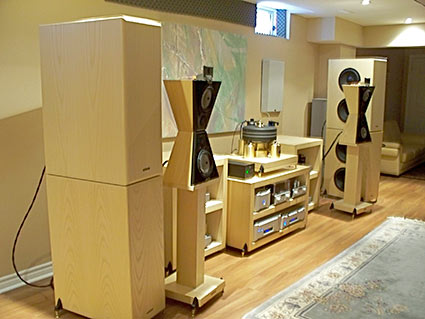
Coincident Reference Room
The result of two years of design work culminated in the development of the Troubador speaker. Using extensive computer modeling, Blume was able to duplicate the sonic properties of a cylindrical enclosure but with the use of non-paralleled flat plane walls. The most significant advantage of this type of enclosure is the elimination of internal standing. In a further attempt to eliminate the sonic contamination of loudspeaker enclosures, Blume uses enclosure tuning techniques. Instead of using resonant enclosure materials and then attempt futilely to damp them out, all Coincident enclosures are constructed from inherently non resonant materials that need no damping. The enclosures are then tuned to a high fundamental resonant frequency that is sonically undetectable.
The culmination of this arduous, painstaking journey has yielded a series of loudspeakers that offer unprecedented performance in each price category. From the Triumph Extreme to the Pure Reference Extreme, Coincident speakers sound better and are better constructed than competing designs at the same price.
Designer Israel Blume has recently realized his goal of building a true reference speaker that encompasses the entire criterion he initially enumerated. That speaker is named the Pure Reference Extreme. This speaker is the most musically authentic loudspeaker from the company and is capable of reproducing the musical signal fed with very high accuracy. Naturally this lead to more development work as amplification driving his speakers was also very critical for accurate music reproduction.
Electronics
Coincident began designing and building amplifiers in 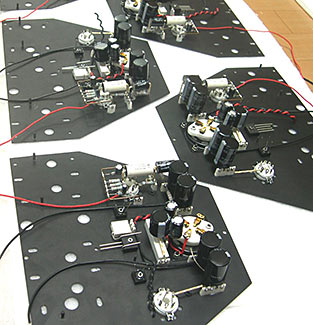 2001
with the introduction of the MP 300B SET mono blocks and the MIP 300B integrated version of the MP 300B.
Both were highly acclaimed and offered build quality and performance unmatched by any other. An intense
R & D program and countless hours of aural evaluation lead to the company's breakthrough M300B
Frankenstein amplifiers in 2005. The design goal of the Frankensteins was to manufacture the finest
amplifier in the world which meant it had to be a single ended 300B design. The fact that most
commercially available loudspeakers were not able to be driven by the purest, low powered amplifiers was
of no concern since all Coincident models were ideally suited to this mode of amplification and some
other well designed speakers were as well. The Frankensteins were designed and manufactured with no cost
restraints. The goal was simple -- it had to be the purest, most transparent, neutral amplifying device
in existence. While the goal was simple, the realization of it was not. It took Blume over three years
of intense research and development, numerous prototypes and literally thousands of hours of auditioning
before the dream was achieved. The M300B Frankenstein amplifiers may sell for a relatively modest price
but there is no competing amplifier that is better constructed or compares sonically at any price.
2001
with the introduction of the MP 300B SET mono blocks and the MIP 300B integrated version of the MP 300B.
Both were highly acclaimed and offered build quality and performance unmatched by any other. An intense
R & D program and countless hours of aural evaluation lead to the company's breakthrough M300B
Frankenstein amplifiers in 2005. The design goal of the Frankensteins was to manufacture the finest
amplifier in the world which meant it had to be a single ended 300B design. The fact that most
commercially available loudspeakers were not able to be driven by the purest, low powered amplifiers was
of no concern since all Coincident models were ideally suited to this mode of amplification and some
other well designed speakers were as well. The Frankensteins were designed and manufactured with no cost
restraints. The goal was simple -- it had to be the purest, most transparent, neutral amplifying device
in existence. While the goal was simple, the realization of it was not. It took Blume over three years
of intense research and development, numerous prototypes and literally thousands of hours of auditioning
before the dream was achieved. The M300B Frankenstein amplifiers may sell for a relatively modest price
but there is no competing amplifier that is better constructed or compares sonically at any price.
Enter The Dragons
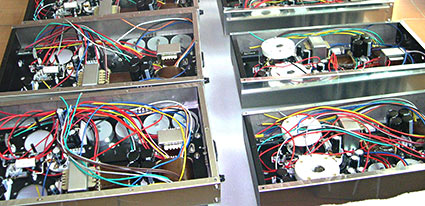
While Blume freely acknowledge that the Frankenstein amplification offered the company's purest sonic reproduction available, Coincident felt there was a need for a high power amplifier that was capable of driving any speaker no matter how difficult a load. However, not only must this amplifier be so capable it had to come as close to the sonic purity of our reference Frankensteins as possible. The result is the Dragons. They are constructed exactly as the Frankensteins using the same components, circuit philosophy and state-of-the-art construction but instead of being single ended triode it uses a pair of high powered 211 DHT tubes operating in push-pull mode. To approach the sound of the Frankensteins yet offer "unlimited drive ability", the Dragons had to use DHT output tubes in push-pull. The driver tube had to be DHT as well and none better than the 300B. The end result is claimed to be an amplifier that sounds like a 500 watt brute yet with 95% of the Frankenstein's finesse.
Preamplifiers
While there is no shortage of line stages available, Israel Blume felt that absolute transparency of the best passive units operating was his design goal. Because of this, Coincident recommended the avoidance of active line stages whenever possible. Thus the company set out to overcome the deficiencies of existing active preamplifiers because of what they felt were inherent advantages of these designs. The Statement Line Stage involves a new way of thinking of preamplification design. Blume felt that existing circuit topologies have proven to be inadequate whether they were solid-state or tube based. A completely new paradigm had to be created. At the heart of this new design was the 101D directly heated triode tube. It has been recognized as the most linear amplifying devise ever made.
To fully exploit the inherent superiority of the 101D, Blume knew it would take a state-of-the-art design utilizing only the finest components executed to the highest standards. After years of research and experimentation, the Statement Line Stage was born. The unit, outside of the tubes, is all transformer coupled, from the input, volume control and right through to the output. There are no capacitors in the signal path and the power supply is huge (41 lbs). The end result is a line stage that is almost noiseless, not prone to hum and passes the musical signal with virtually no perversion. For the company it represented a sonic breakthrough since it combined the best qualities of passive designs with the inherent advantages of an active preamplifier.
The Coincident Sound
Mr. Blume is often asked, "What do Coincident Speakers sound like?" Their answer, "We try our hardest to make them sound like nothing. The theoretically perfect audio component would sound like nothing. It would simply transmit the signal it is being fed with no alteration, enhancement, subtraction or distortion. Our goal with all Coincident models is for them to pass as much musical information with the least possible coloration. Coincident speakers do not editorialize or attempt to glamorize the sound.
For example, there is no intentional boosting of the midbass to provide the illusion of more bass, nor the rolling off of the high frequencies to make the resultant sonics more pleasing. Coincident Speakers are designed to be as musically accurate as possible. We attempt to create an open window on the musical event, with nothing interfering between the music and the listener. Consequently, Coincident Speakers are very revealing of the musical source, the room in which they are placed and the ancillary components used. It must be emphasized that high resolution does not connote low musicality. On the contrary, the better a component is at revealing the information it is sent, the more accurate and by definition, the more natural it will be since it will closer approximate the live music listening experience." Coincident Speaker Technology is proud to still state that unlike the majority of current speaker companies (i.e. Revel, Aerial, Von Schweikert, Red Rose etc.) all its speaker models are designed and completely manufactured in Canada.
More Details About Coincident Speaker Technology
All the crossovers are meticulously hand soldered in Canada, matched to within 1% tolerances using the finest Canadian and American components. Coincident does not use poor quality overseas-sourced crossovers that are pre-built and cost a couple of dollars. The price of one capacitor used in a Coincident speaker crossover exceeds the cost of these entire crossovers that are finding their way into very expensive competing speakers.
All internal wiring is manufactured in Canada using American 6N copper. Only the finest Canadian dielectrics like polypropylene and air Teflon are used. Coincident Speaker Technology's wire is very expensive to manufacture and labor intensive to terminate. There is no use of off shore cables that Blume feels are sonically inferior and costs only a few pennies.
All Coincident speaker enclosures are meticulously CNC and hand crafted at their facilities in Canada. Only the highest quality Canadian made hardwood MDF is used, all wrapped with furniture grade cherry wood veneer that is carefully pressure applied on both sides of the board. Coincident chose to build their enclosures in Canada to ensure high quality.
All the drivers of Coincident speakers are sourced from only state-of-the-art manufacturers such as Scan-Speak, Vifa and SEAS. Coincident does not use any knock-offs cheaply manufactured drive units that are copies of the above noted brands. Only the very best drivers sourced from the finest manufacturers are chosen.
Coincident Speaker Technology is committed to providing the high-end audiophiles with the finest value components in the world. Coincident, therefore, will never sacrifice quality. No detail is considered too trivial if it enhances the sonics or build quality of their products. "Coincident will never offer an inferior product in pursuit of greater profits" says the owner Israel Blume.
Israel Blume continues by saying "Coincident components exist for only one purpose: to provide the discerning music lover with the finest sounding, best built products that above all else, enhances the musical experience."
Company Information
Coincident Speaker Technology
19 Strauss Road
Thornhill
Ontario, Canada L4J 8Z6
Voice: (905) 660-0800
Fax. (905) 660-1114
E-mail: iblume@coincidentspeaker.com
Website: www.CoincidentSpeaker.com
TAS 2013 Award | Editor's Choice Awards
|
Pure Reference
Extreme |
Editors Choice
The Absolute Sound |
 |
|
Super Victory
|
Editors Choice
The Absolute Sound |
|
|
Partial Eclipse II
|
Editors Choice
The Absolute Sound |
|
|
M300B Frankenstein Amps
|
Editors Choice
The Absolute Sound |
|
Coincident Speaker Technology • Pure Reference Extreme Loudspeakers
A genuinely high-end, full-range partner for low-powered amps -- and much more besides.by Roy Gregory | February 17, 2012
www.theaudiobeat.com
There's an old adage, at least in this part of the world, that it's easier to build efficiency into a speaker than power into an amplifier, yet it's a pearl of wisdom that is all but ignored by speaker and amplifier manufacturers alike. Of course, it comes with the considerable caveat that (where speaker enclosures are concerned) size can't matter, but, with that literally not-so-small proviso, it's a philosophy that has a lot going for it -- though like most such sayings it's somewhat simplistic. Even so, let's just dwell on the subject of efficiency for a moment or two.
Price: $26,800 per
pair.
Warranty: Five years parts and labor.
Coincident Speaker Technology
19 Strauss Rd.
Thornhill, Ontario, Canada
L4J 8Z6
(905) 660-0800 www.coincidentspeaker.com
If we consider a hi-fi system's efficiency in terms of its ability to convert electrical power into acoustic output, then the results are pretty lamentable. Even horn systems with three-figure sensitivity score pretty poorly in this regard, so imagine what happens when you start building a speaker system with diminutive internal dimensions and still insist on extended bandwidth; not only does the sensitivity plummet but the impedance characteristic (and thus the load seen by the amplifier) turns something cruel. The end result is a loudspeaker that demands both considerable power and significant load tolerance.
TAS 2012 Award | Editor's Choice Awards
|
Pure Reference
Extreme |
Editors Choice
The Absolute Sound |
 |
|
Super Victory
|
Editors Choice
The Absolute Sound |
|
|
Partial Eclipse II
|
Editors Choice
The Absolute Sound |
|
2011 Saw Another Year with Many Prestigious Awards
Garnered by Coincident
|




Coincident Pure Reference Extreme Loudspeaker
$ 26,800
by TAS Issue 215
View printed
review
 The Coincident Pure Reference Extreme (CPRE) may be the
most accurate and true-to-life loudspeaker on the market today. It's actually the opposite of the
MBL. It does not recreate a concert, it does not beautify recordings; and it looks relatively
ordinary. Considering all the MBL does right, the Coincident does the same things more realistically
and correctly. It is a thinking man's loudspeaker that speaks the truth whether or not you want to
hear it. When I say more realistically, I mean that literally. The imaging is the best in the
business. It's exactly what the microphone(s) picked up and it replicates what the recording
engineer intended you to hear. Let me be clear: The Coincident allows you, for the first time, to
experience that actual craft of the engineer. Countless examples of crappy, thin, or compressed
recordings are deconstructed by the Coincident and reassembled in a more realistic fashion. It's as
if other speakers smear the sound. And it's all presented, phase perfectly, in a broad array across
your room-an immersive Holodeck of sound.
The Coincident Pure Reference Extreme (CPRE) may be the
most accurate and true-to-life loudspeaker on the market today. It's actually the opposite of the
MBL. It does not recreate a concert, it does not beautify recordings; and it looks relatively
ordinary. Considering all the MBL does right, the Coincident does the same things more realistically
and correctly. It is a thinking man's loudspeaker that speaks the truth whether or not you want to
hear it. When I say more realistically, I mean that literally. The imaging is the best in the
business. It's exactly what the microphone(s) picked up and it replicates what the recording
engineer intended you to hear. Let me be clear: The Coincident allows you, for the first time, to
experience that actual craft of the engineer. Countless examples of crappy, thin, or compressed
recordings are deconstructed by the Coincident and reassembled in a more realistic fashion. It's as
if other speakers smear the sound. And it's all presented, phase perfectly, in a broad array across
your room-an immersive Holodeck of sound.
The CPRE is a three-way design that functions more like a two-way with
a subwoofer. Its super-fast ceramic Accuton mid- and high-frequency drivers cover the ground from
100Hz to 27kHz. The woofers are tonally correct with perfect pitch and definition. If you are
accustomed to midbass (chesty) exaggerations, you'll have to rewire your thinking. Once you do,
you'll never go back. The crossover is simple and first-order. The sensitivity is 94dB, and the load
is tube-amplifier-friendly.
Over the years, TAS Executive Editor Jonathan Valin has “ticked” numerous Magneplaners as the best bang-for-the-buck in high-end loudspeakers (and does again in this GE-Ed.). I'm going to add the Coincident Pure Reference Extreme as one of the very best performance-for-dollar products in the ultra-high-end market today. The CPRE is downright magical with low-output triode amplifiers, but is also surprisingly realistic and vivid with big solid-state amps. Not to mention, it's out of this world with vintage Heathkits and Fishers. The CPRE is on of the most versatile and realistic loudspeakers available today. (Reviewed in Issue 209)
We are now excited to introduce the MK. II version of the highly acclaimed
Dragon amplifiers. The improvements include:
1. Dual power transformers in place of the previously used single unit.
The new transformers individually possess the capability of powering the amplifier. In tandem, they
are coasting only using less than 25 % of their rated capabilities. The result is a far cooler
operating amplifier, thereby improving reliability and long term
stability. Additionally, the Dragon is now virtually noiseless. It is incredibly quiet which is a
remarkable feat for an amplifier this powerful operating at such high voltages. Sonically there is
an improvement from top to bottom. The bass is tighter, deeper and punchier. The mids and highs are
more transparent and the soundstage more expansive. Due to the reduction in noise, overall
revelation of low level detail is enhanced.
2. Chassis Rigidity - To accommodate the dual transformers of the MK.
II Dragons, the chassis has been enlarged by 20%. The amplifiers are now 2" wider and 2" deeper and
1" higher. They now weigh 85 lbs, which is 20 lbs heavier than the previous model. The chassis is
now more rigid which results in the virtual elimination of chassis induced resonances. The MK. II
now utilizes 6 ceramic isolating feet to stabilize the unit.
3. The standard supplied 211 tubes will now be the exceptional Shuguang Pevane.
They represent a marked sonic improvement over the previously supplied standard Shuguang. The Pevane
is also more durable and reliable and runs 15% cooler.
4. AC ground lift is now included. This switch conveniently eliminates
hum created by AC ground loops.
The MK. II Dragon is now the finest sounding, high power amplifier in existence. Its
purity is within a hair's breath of the finest SET 300B amplifiers (the Frankensteins) yet its
power delivery is awe inspiring. It also runs cooler and is exceptionally quiet.
The purity, transparency and continuousness of a DHT SET but with the power, explosive dynamics, weight and impact of a huge push pull pentode amplifier - sounds mutually exclusive, not any longer. The 211PP Dragon mono amplifiers are such a creation. These amplifiers are absolute state of the art in terms of components selected, circuit design and execution and construction quality. This is unique among high power, push pull DHT triode amplifiers. There has never been a high power, DHT amplifier built to this standard with sonic performance at this level. The Dragons are capable of driving even the most difficult speaker loads.
Features include:
- The finest 6N copper interstage, output and dual power transformers
- No coupling caps in the signal path
- Tube compliment- 6EM7 super tube for input- So much current capability it has its own power supply
- 300B Driver Tube for utmost purity ( no pentode tubes used in this DHT design)
- Dual 211 Shuguang Pevane output tubes in a push pull configuration which dramatically lowers distortion and provides huge power reserves. (over 120 watts of peak power- 80 watts continuous- sounds more like 150 watts)
- Teflon caps use in cathode bias circuit
- Power supply caps are all 1500V polypropylenes
- Highest quality discrete resistor potentiometer permit the direct connection of a CD player thereby obviating the need for an expensive line stage
- Binding posts are Coincident 6N copper, .25" solid post
- Auto bias
- All resisters, red metal film, 1% and none less than 2 watts
- All meticulously hard wired
211pp Dragon MK. II Mono Amp
Output Power: 75w (Triode) / Push-Pull Class A
Output Impedance: 8ohm,16ohm
Frequency Response: 20hz-20khz ±1db
T.H.D.: <1%, 20hz-20khz (Ref. Output)
Input Sensitivity: 1v
Input Impedance: 100kohm (Rca)
S/N: >90db
Tubes: (6EM7×1, 300B×1, 211×2) / Channel
Power Requirement: Ac 115v Or 230v±5% 50/60hz (Selectable)
Dimension: 270 W x 189 H x 520 D (mm)
Gross Weight: 41 Kgs
Net Weight: 38.5 Kgs
Price:
$10999 US /pr. includes freight.
$ 9999 US/pr. when purchased with any Coincident speaker.
Coincident's Reference System:
Featuring Double Pure Reference Extremes
"This system points out some significant flaws in my own. I would like to adopt it as
My Reference in Absentia. Listening to my familiar music on CDs and your LPs had a profound impact I will be processing the experience for quite some time, I expect.
Quite simply- it was incredible.
Thank you, Israel."
Rick Becker- enjoythemusic.com
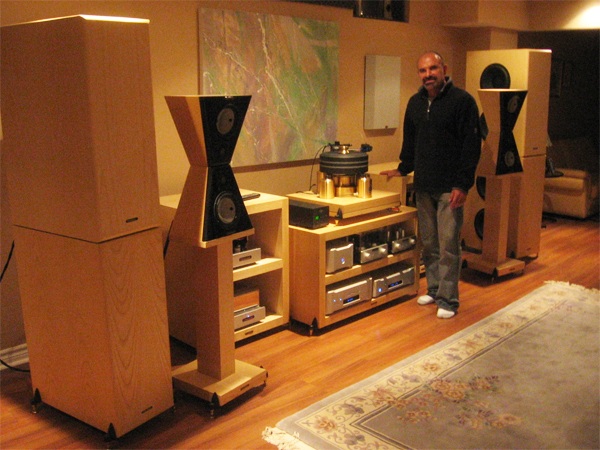
NOW ADDED TO CLASS A MOVING COIL STEP-UP DEVICES
COINCIDENT STATEMENT M/C TRANSFORMER -
by www.high-endaudio.com
The Coincident Statement is now the finest MC step-up I've ever heard, of any type. The discovery of
a new reference component is always a cause for a "celebration", though, in this case, it
will have to be tempered. This is because the Coincident's degree of superiority over the former
reference, the Bent Audio Silver, is quite subtle. In fact, to even initially hear the differences
took numerous A/B/A/B comparisons (after basic A/B comparisons failed for me).
Read full review at www.high-endaudio.com
COINCIDENT PURE REFERENCE "EXTREME"
by www.high-endaudio.com
The "Extreme" is simply the "Original" Pure Reference, with the exact
same drivers and crossovers, but in two separate cabinets (a
mini-monitor and a subwoofer), instead of one large floorstander. With the monitor sitting directly
on top of the subwoofer (at the front), the Extreme is around 12" shorter,
though its subwoofer takes up around 50% more floor space, because it is 4"
wider. The price for the Extreme is $ 26,000, compared to $
22,000 for the Original.
Read full review at www.high-endaudio.com
Passive Preamp- In essence is merely a volume control designed to attenuate the signal going from the source (usually a CD player) to the amplifier. Since it is passive, it has no inherent gain because it has no active components (tubes or transistors) in the signal path.
The quality (sonic purity) will be largely dependant on the volume potentiometer used. The finest discrete resistor pots will sound more accurate than a variable one, for example, since the signal travels through only one resistor at any given setting and is therefore not dependant on volume position as is the case with a variable pot. Many believe that transformer volume controls can be superior to even the best discrete resistor pots, since the TVC is inherently passive while the latter still requires the audio signal to traverse a resistor. The TVC is more costly to properly implement since the best transformers are very expensive.
Type, length and quality of the internal wire will also affect the sound as will the connectors being used. The inclusion of a selector switch will compromise the ultimate transparency of the sound to a greater or lesser degree compared to a passive eschewing this switch.
Active Preamp- Not only controls the volume of the source component but since it uses active devices (tubes or transistors) in the signal path it has gain. The active preamp inherently has many components in the signal path compared to a passive. It uses all the components of the passive with the addition of a power supply, capacitors, resistors, gain devices, and means by which all these parts are connected.
Logic would seem to dictate that the active preamp must adulterate the signal to a far greater degree than the passive by virtue of all those additional components.Further, since the active has the additional disadvantage of requiring a power source, tubes or transistors it must not only impose far greater noise, it is also more costly and inconvenient to use. Why would anyone want to use the active in a system? Theoretically, it would seem nonsensical to use anything but a passive preamp.
The Imposition of the Real World –
Passive Preamp - While it is inherently simpler in design with no active components in the signal path, it is highly susceptible to component interaction. The affects of the IC cable (impedance, capacitance and resistance), the source resistance which is the combination of the potentiometer and the actual source and the input impedance of the amplifier are all critically important in potentially altering the audio signal from source to the ultimate sound being heard.
The length of the cables between the source and passive and then to the amplifier must be strictly attended to. Too long a cable and roll offs at both frequency extremes will occur. Impedances between the volume control and the imput impedance of the amplifier must be compatible in order to avoid sonic degradation. Furthermore, since a passive has no gain, the output voltage of the source component must be sufficient and the amplifier and the speakers need to be of high sensitivity or not enough ultimate volume can be achieved.
The purest, simplest but admittedly most inconvenient method of passive attenuation is to have discrete resistor pots installed at the amplifier input. This method avoids the extra cable interaction and achieves the desired amplifier input impedance.
To summarize, in order for a passive preamp to work properly the following conditions must be met:
1. Source component must have sufficient ouput voltages;
2. Short, low capacitance cables must be used between the source to the passive and from passive to the amplifier;
3. Output impedance of the passive's volume pot should be low (less than 25k) while the input impedance of the amplifier should be sigificantly higher (100k);
4. Amplifier's input sensitivity should be high (minimum of .75v for full output).
5. Speakers should be high sensitivity (minimum of 90db).
If even one of the above conditions is not adhered to, passives will offer highly compromised sonics. However, when all of the above conditions are met, there are very few active preamps on the market that will yield better sound overall. For an active to provide superior sound, will require an amazing unit designed and executed to the highest level. (translation- it will not be cheap- but do not confuse excessive price with high performance- however high performance will be expensive).
Active Preamps - Due to the use of a myriad of components in the signal path, most active preamps severely color the sound. The signal entering them rarely resembles the sound exiting them. Theoretically, an active preamp should emulate a straight wire with gain. It should be as pure and transparent as the finest passives in an optimized system yet offer the benefits of gain and nonsusceptibility to component or cable interaction. This task would seem impossible to fully achieve and arguably no active preamp currently available has been completely successful in its accomplishment. The realistic goal of an active preamp is to provide sound with all the advantages inherent in the design with drawbacks that are so minor as to wither into insignificance when viewed in its totality. Achieving this objective requires the following:
1. The finest passive and active components available connected with the shortest signal paths possible;
2. A power supply that is impervious to voltage fluctuation or current demands;
3. The finest form of signal attenuation;
4. The purest gain devices;
5. Low output impedance;
6. A highly rigid chassis that is not prone to resonances.
The inherent practical advantages of an active over a passive is that due to output buffering, interaction between the source, connecting cables and amplifier input impedance ceases to be an issue. Further, due to added gain, much greater flexibility in system assembly is possible.
The other huge advantage presented by an active line stage is that it amplifies the source signal to a higher level, unlike a passive design which has no gain, so that the power amplifier is able to more accurately pass this signal to the speakers. This is similar to what occurs when inserting a moving coil transformer or head amp into a low gain phono stage. The low level cartridge signal becomes amplified so that the phono preamp can transmit this incoming signal more accurately to the amplifier. While the system now has an extra component in the signal path which would intuitively create the impression that purity would be compromised, the opposite results- greater fidelity is achieved. Not only is the sound more dynamic, harmonically more complete with superior rendering of the frequency extremes, there is a noticeable enhancement in detail retrieval.
Coincident has up to the advent of our Statement Line Stage recommended the use of the best passives when all the system conditions were optimized. The sonic compromise inherent with all previously auditioned active units in terms of imposed colorations were too obtrusive to ignore, despite their other advantages.
Coincident Statement Line Stage -
All the requirements mentioned above to create the superior active preamp have
been met. The end result is an active line stage that is virtually as pure and transparent as not
only the best passives but as accurate as going directly from the source component to the amplifier
using the finest 1m interconnect. The sonic leap in dynamics, weight, impact and punch as well as
full extension at both frequency extremes is dramatic.
The enhancement of musical enjoyment wrought by the insertion of the Coincident Statement Line Stage
into an audio system is of enormous proportion. As reviewers and owners of the unit have confirmed,
the superiority of the Coincident over passives and existing active preamps is not subtle. A short
audition is all that is required to hear this level of advancement.
300B Tubes For Frankenstein Amplifiers
As of April 15/ 2012, Frankenstein and Dragon amplifiers will be supplied with Shuguang Psvane clear
bottle 300B tubes as standard.
The finest 300B available is the Shuguang Treasure Black Bottle. Not only are the
sonics the best we have heard, we have not experienced a single failure in the field. We have not
heard a superior sounding tube, nor one that is more reliable. Coincident supplies matched and
tested pairs.
We are hesitant to recommend any of the mesh plate 300Bs since they tend to be prone
to microphonics due to the inherent resonant nature of their internal structure. We also have
stopped recommending KR 300Bs, despite their superb sound, due to their poor
reliability and the manufacturer's reluctance to honor their warranty.
If anyone has any questions or comments about 300B tubes in the Frankenstein amplifiers, feel free to contact us.
VIDEOHIFI interviews Coincident Speaker's Israel Blume
Coincident Speaker Technology is proud to still state that unlike the majority of current speaker companies (i.e. Revel, Aerial, Von Schweikert, Red Rose etc.) all its speaker models are designed and completely manufactured in Canada.
All the crossovers are meticulously hand soldered in Canada, matched to within 1% tolerances using the finest Canadian and American components. Coincident does not use poor quality Asian sourced crossovers that are pre built and cost a couple of dollars. The price of one capacitor used in a Coincident speaker crossover exceeds the cost of these entire crossovers that are finding there way into very expensive competing speakers.
All internal wiring is manufactured in Canada using American 6N copper. Only the finest Canadian dielectrics like polypropylene and air Teflon are used. Our wire sounds the best and is very expensive to manufacture and labor intensive to terminate. Other high end speaker companies use off shore cable that is sonically inferior and costs pennies.
All Coincident speaker enclosures are meticulously CNC and hand crafted at our facilities in Canada. Only the highest quality Canadian made hardwood MDF using furniture grade cherry wood veneer which is pressure applied on both sides of the board is utilized. Having our enclosures made in China, as most other speaker manufacturers, would save 80%-90% of the cost. However, we would not even think of doing this since the quality of workmanship simply does not compare. Inspect a Coincident enclosure with those made in China and the difference is painfully obvious. Coincident will never sacrifice quality for profits.
All the drivers of Coincident speakers are sourced from only state of the art manufacturers such as Scanspeak, Vifa and SEAS. Coincident does not use any Chinese manufactured drive units that are knock offs of the above noted brands. Many high end speaker companies no longer use the expensive, best sounding drive units made by these European companies, instead opting to use inferior sounding and incredibly cheap (costing as little as a couple of dollars) Chinese units that are almost visually identical. The consumer is fooled into believing he is buying an expensive speaker using Scanspeak drivers when in reality the drivers are very cheap poor quality units that only physically resemble those drivers.
Coincident Speaker Technology is committed to providing the high end audiophile the finest value loudspeakers in the world. Coincident, therefore, will NEVER sacrifice quality. No detail is considered too trivial if it enhances the sonics or build quality of our speakers. Coincident will never offer an inferior product in pursuit of greater profits. Therefore, none of our speakers will be made in China nor will any of our models use inferior components because they are inexpensive to purchase and will increase our profit margins at the expense of quality. Coincident speakers exist for only one purpose: to provide the discerning music lover with the finest sounding, best built loudspeakers available anywhere near their selling price.
The Coincident Sound
We are often asked, "What do Coincident Speakers
sound like ?" Our answer, "we try our hardest
to make them sound like nothing". The theoretically
perfect audio component would sound like nothing.
It would simply transmit the signal it is being fed
with no alteration, enhancement, subtraction or distortion.
Our goal with all Coincident models is for them to
pass as much musical information with the least possible
coloration. Coincident speakers do not editorialize
or attempt to glamorize the sound. For example, there
is no intentional boosting of the midbass to provide
the illusion of more bass, nor the rolling off of
the high frequencies to make the resultant sonics
more pleasing. Coincident Speakers are designed to
be as musically accurate as possible. We attempt to
create on open window on the musical event, with nothing
interfering between the music and the listener. Consequently,
Coincident Speakers are very revealing of the musical
source, the room in which they are placed and the
ancillary components used. It must be emphasized that
high resolution DOES NOT connote low musicality. On
the contrary, the better a component is at revealing
the information it is sent, the more accurate and
by definition, the more natural it will be since it
will closer approximate the live music listening experience.
Those seeking to replicate the thrilling experience
of listening to live music will greatly appreciate
the "Coincident Sound". Our reference standard
is live music and our goal is to get as close to the
sound of real instruments playing in a real space,
as present technology will permit.
Why
Biwire?
Biwiring is when a loudspeaker has separate connections
to the bass and the treble/midrange. The idea is to
use individual speaker cables to each section. Besides
being profitable to cable manufacturers, since the
user is required to purchase double the amount of
speaker wire, are there any sonic benefits to this
arrangement?
The answer is yes and no. Yes it is a benefit for
loudspeakers that are not properly designed. In speakers
where the crossover sections are interdependant and
not adequately isolated from one another, biwiring
will likely offer a sonic benefit. However, in speakers,
(like all Coincident models), that have all the crossover
sections, (high pass, low pass etc), completely separated
and isolated from one another and are run to the binding
posts, (as opposed to being interconnected between
sections and wiring all the hots and grounds to the
speaker's binding posts), biwiring affords NO sonic
advantage and may actually involve a sonic degradation
depending upon the speaker cable used.
Coincident recommends biwiring only in those cases
where a consumer has the intention of biamping his
speakers. A biwiring option will be necessary if one
is biamping a system, meaning separate amplifiers
will be powering different drivers. Otherwise, biwiring
is not only totally unnecessary and a waste of money,
but a pain in the derriere.
Mirror
Imaged Side Firing Woofers - Advantages
Unlike the majority of other speaker companies that
place their woofers on the front of their speakers,
Coincident mounts their woofers on the side of the
enclosures in a mirror imaged configuration.This is
done because there are 3 distinct advantages with
NO downside.
TOP
1. Elimination of Diffraction Effects -
Since the largest drivers,(the woofers), are mounted
on the side of the enclosure, the front baffle can
be made as narrow as the smaller midrange drivers,
thereby eliminating diffraction effects, (which are
responsible for impairing image width and creating
high frequency smearing).
2. Flexibility of Speaker Placement -
Because the side firing woofers are mirror imaged,
there are two positions to avoid room standing waves
- woofers aiming to the inside or to the outside.
In a room devoid of standing waves, (a very rare phenomenon),
there would be absolutely no sonic difference whether
the woofers were firing inside or outside, (so long
as there is sufficient distance to the side wall in
the case of outside firing). This is so because the
crossover frequency to the woofers is so low, (typically
125 hz), where the wavelengths are very long, (in
the range of 9 ft). This means that the woofers can
be placed a distance as much as 9 ft away from the
midrange units and still achieve seamless driver integration.
The Stereophile Show 2001 provides a dramatic real
world illustration of the benefits of mirror imaged
side firing woofers. The demonstration rooms were
plagued with a standing wave centered at 100 hz (
elevated in amplitude by 12db!). This was the case
when the Total Eclipse woofers were firing to the
outside and as other exhibitors experienced, when
the woofers were front facing . However, when the
woofers aimed to fire to the inside, the room standing
wave was avoided and flat frequency response to below
30 hz was achieved.
3. Simulation of Steep Crossover Slope-
Since high frequencies are directional, (low frequencies
are not), aiming the woofers to the side of the listening
position causes out of band high frequency information
to be attenuated, thereby simulating an acoustical
high pass filter. Therefore, the electrical first
order crossover (chosen for reasons of purity and
phase coherency- attenuates out of band frequencies
at a rate of 6db per octave), of Coincident speakers
act more like an acoustical third order slope (with
its advantages of steeper attenuation- 18db per octave-
of unwanted out of band high frequencies), but with
no sonic penalty since no additional electrical components
are added to the signal path.
Amplifier
Power - How Much Is Enough?
This is a question that is asked almost more frequently
than any other.As with most issues in audio,the answer
is complex and depends upon the following:
1. Speakers being used- Sensitivity and the impedance
curve being critical.
2. Personal preferences of the listener- Type of music
listened to and at what output levels.
3. Size of room - To fill a larger room will take
proportionally greater amplifier power.
Speakers-
Acoustical output is dependant upon the power of the
amplifier used and the efficiency with which the speaker
being driven can transform the electrical signal into
sound.The term "sensitivity" is a speaker
measurement that reveals how much sound (in decibels)
is produced at a specified distance, (usually 1 meter),
from the speaker when it is fed a specified input
signal, (usually 2.83 volts which is equivalent to
1 watt into 8 ohms). Therefore, a more sensitive speaker
that has a flat, benign impedance curve (of 8 ohms
or more), will produce greater acoustical output with
the same specified amplifier power than a less sensitive
speaker or an equally sensitive speaker that has a
reactive, low impedance modulus. For example, a speaker
that is 3 db more sensitive than another will require
only half the amplifier power to generate the same
sound output.
If a speaker has a sensitivity rating of 85 db @1
watt - 1 meter, to achieve an output of 88 db would
require double the amplifier power or 2 watts.91 db
output would take 4 watts. For 100 db output of sound,
would require 32 watts of power. And if this speaker
was rated at 4 ohms, a 64 watt amplifier would be
needed to produce 100 db.
By contrast, a 94 db sensitive speaker would require
only 4 watts to achieve a 100 db output level. Since
most listening in the home environment is undertaken
at 85 db or less, it can be clearly seen that only
a fraction of a single watt of amplifier power is
all that is required for the vast majority of listening.
A 100 db output, which is loud, still needs only 4
watts of power to attain. However, it must be emphasized
that while listening at an average level of 100 db,
during musical passages that are very dynamic with
lots of low bass content, many hundreds of watts may
be necessary, (albeit for only the duration of a millesecond),
to avoid amplifier clipping.
The above example clearly demonstrates how significant
the sensitivity and impedance curve of the loudspeaker
is upon determining how much amplifier power is necessary.
Personal Preferences of the Listener-
As the above example illustrated, higher listening
levels requires greater amplifier power. Therefore,
the output levels the listener chooses to listen at,
will be critical in determining the amount of power
that will be satisfying. The listener who is content
at levels of 80 db will need a fraction of a watt
while someone who likes to listen at 105 db will be
using almost 260 times more power!
Of equal importance is the type of music enjoyed.
Full orchestral music, for example, is very demanding
on amplifier power in order to reproduce the exceptionally
high levels of dynamics coupled with very low bass
content (which uses enormous amounts of power). Conversely,
chamber music, light folk etc. is usually listened
to at lower SPLs and its musical content requires
far less amplifier power to accurately reproduce.
Furthermore, some listeners prefer a punchier, gutsier
sound presentation than others whose priorities lie
more in the area of detail retrieval, imaging etc.
For some, visceral impact is mandatory or at least
may represent much more of a priority than it is to
others. These personal predilections must be factored
into the equation of how much power is sufficient.
Room Size -
All things being equal, the larger the room, the more
amplifier power required to fill it. The sensitivity
rating of a speaker is the measurement of acoustical
output at a distance of 1 meter. The further away
the listener is from the speaker, the lower the sensitivity.
Therefore, a speaker producing 94 db from 1 watt of
amplifier power at a distance of 1 meter will produce
less sound pressure when the listener is 2 meters
away. For a speaker to energize a room of 1000 cubic
feet, for example will require significantly less
amplifier power than to do the same in a 2000 cubic
foot space. As a real world example, at the recent
2001 CES, Coincident demonstrated in a hotel suite
of 1872 cubic feet using a 24 watt amplifier. To achieve
similiar sound pressure levels and bass impact in
another space of 7200 cubic feet, required 3x the
amplifier power.With the same 24 watt amplifier in
the much larger room, the sound was not as weighty,
impactful or as dynamic as it was in the aforementioned
smaller environment.
Conclusion-
With easy to drive speakers, like Coincident, many
are afforded the opportunity of using low powered
amplifiers like SETs with completely satisfying results.
For those in a compact room, who listen at moderate
levels to jazz , light rock, folk etc, then the inherent
superiority of the best SETs will be appreciated.
That is not to suggest that SETs are for everyone.They
are decidely not. If your musical tastes are focused
on big orchestral music, heavy rock, etc., and you
listen at high spls in a large listening space, then
small tube amplifiers may not be your sonic cup of
tea. It would be recommended that a more robust amplifier
be used.
06/29/01
Solid State Amplifiers:
With transistor amplifiers ,the amp's output impedance is never matched to the load it drives.The lower the load impedance ,the closer it comes to a true impedance match , because the output impedance of a solid state amp is very low - typically a fraction of an ohm.This helps explain why (all things being equal- and the amplifier has sufficient current capability)4 ohm speakers produce greater acoustical output than 8 ohm speakers.The lower impedance speaker offers less resistance to current from the amp.The transistor amp sees less resistance into 4 ohms , therefore its output stage delivers more current.
Tube Amplifiers:
A tube amplifier's output stage(s) are totally different. A true match between the load impedance and the plate impedance ( or plate - plate impedance of a push - pull tube output stage) is never absolutely possible.The tube's plate impedance is typically exceptionally high
( thousands of ohms.) Therefore ,even a tube output transformer ( which becomes necessary to lower the plate impedance so that a typical speaker can be driven) with a primary impedance of 3K - 8K ohms will not closely approach this match. Therefore, it can be seen that the operation of tube versus solid state outputs is reversed. In the case of transistors, impedances cannot be matched due to the ultra low output impedance of the amp ,while with tubes, the match cannot be achieved because of the very high output impedances.
The output transformer in a tube amp lowers its impedance to a level where speakers can be made to operate and extract power from the driving amplifier. The output transformer is designed with a given ratio between the number of turns of wire in the primary and a nominal secondary impedance. For example, if we connect an 8 ohm loudspeaker to an amplifier with a primary impedance of say, 5,000 ohms and a transformer tap of 8 ohms, the primary impedance remains at 5,000 ohms and the amplifier delivers a given amount of electrical power. But ,if a 4 ohm speaker is connected to this amplifier, the output volume will diminish because the 4 ohm load causes a reduction of the primary winding impedance. This reduction means the amp's output transformer presents a poorer match to the plates of the tube output stage than it previously did.
On the other hand, if a 14 ohm loudspeaker is connected to the same 8 ohm tap, the primary winding's impedance is increased. The transformer represents only a ratio of turns and its impedance is determined by the load connected to it. Because the transformer's impedance has increased, it comes closer to matching that of the plate circuit. The result is greater output volume from the speaker.
In conclusion, a tube amplifier will produce more output ( greater voltage delivery) into higher impedance loads. Therefore , a 14 ohm speaker will be much more efficiently driven by a tube amplifier than will a 8 or 4 ohm speaker. This becomes of critical importance when using OTL or single ended triode tube amplifiers when available output power is low and amplifier output impedance is very high.
Available Options for Coincident Speakers
Biwire Terminals- (available on all Coincident
models) Not recommended (unless one intends to
biamp) since it involves no sonic benefit. Will be
available for those who insist.
Price: $250 US /pr.
Cables- What is Important?
I would like to address some technical points applicable
to speaker cables in general and how they apply to
the Coincident CST1 and TRS speaker cables in particular.
It is commonly mentioned that capacitance is an important
factor in speaker cable performance. This is incorrect.
A speaker cable's capacitance is in parallel across
the power amp output, not in series with the signal.
The musical signal does not go through the cable's
capacitance to go back and forth between amp and speaker.
Therefore, speaker cable capacitance has very little
deleterious consequences upon the accurate transmision
of music along the length of the cable.
On the other hand, resistance, and even more significantly,
inductance, both have very profound affects on the
musical signal.
The resistance of a cable is determined by its cross
sectional area and by the material of the conductor.
The larger the gauge, generally the lower the resistance.
Low resistance cables have a low propensity to effect
frequency response deviations with a given loudspeaker
while high resistance cables have a higher propensity to
do the same. The sonic affect of the cable will be
dependant upon the impedance characteristics of the
loudspeaker. A high, flat impedance speaker will cause
little or no frequency response deviations (even with
a high resistance cable), but with a loudspeaker that
has impedance dips, a high resistance cable will superimpose
more of a frequency response deviation.
Self inductance is determined by the physical intimacy
of the 2 conductors of opposite polarity (hot &
ground). The more intimately intertwined the conductors
,generally speaking ,the lower the inductance.Without
getting too involved,it is safe to state,that the
lower the inductance, the more extended the high frequencies.The
higher the inductance ,the more rapidily will the
high frequencies begin to roll off.
Both resistance and inductance,unlike capacitance,are
critical to accurate reproduction, because they are
in series with the amp and the speakers. The music
must pass through the cable's resistance and self
inductance.
It is precisely for the above noted reasons that the
Coincident CST1 and the Total Reference Series speaker cables ,have been designed to be low
resistance and ultra low inductance and only medium capacitance.The proof of any design ,is
the sonic results with a very wide range of available
associated components.Our experience and those of
many hundreds of Coincident cable owners would appear
to substantiate that Coincident cables sound superb
with virtually all components.
Cable capacitance may be relevant in cases where circuit
impedance is high.It is therefore not recommended to have high cable capacitance on the
output circuit of a preamp with a source impedance
of a 500 ohms or higher.The output circuit impedance
of a power amp is however,very low, usually in the
range of .1 to .5 ohms which is far too low to be
affected by the shunt capacitance of even the highest
capacitance speaker cables. The only possible exception
where high speaker cable capacitance could be audible
would be the case of a high output impedance preamp
being mated to a very high output impedance amplifier
like a Sonic Frontiers, (somewhere in the range of
6 - 10 ohms), connected to a low impedance loudspeaker.

